

Introduction
The US retail industry is becoming increasingly data-driven as retailers, manufacturers, brands, and e-commerce businesses compete to deliver better prices, broader product selections, and convenient shopping experiences. Walmart, one of America's largest retail platforms, offers a valuable digital marketplace for understanding consumer demand, product positioning, competitive pricing, and assortment changes.
A structured Walmart product dataset helps businesses examine product listings, prices, categories, brands, product specifications, availability, and seller information across different retail segments. Instead of manually checking thousands of product pages, retail teams can use organized datasets to understand market movements and identify commercial opportunities.
Access to reliable Walmart product data also helps businesses evaluate how products are positioned against competitors, which brands dominate specific categories, and how discounts influence purchasing decisions. These insights support pricing strategies, assortment planning, category management, and competitor benchmarking.
A comprehensive Walmart price dataset can additionally capture regular prices, promotional prices, unit prices, and price changes over time. When collected consistently, these records help retail analysts understand discount patterns, identify pricing gaps, and evaluate how products perform across different categories.
1. What Is a Walmart Product Dataset?
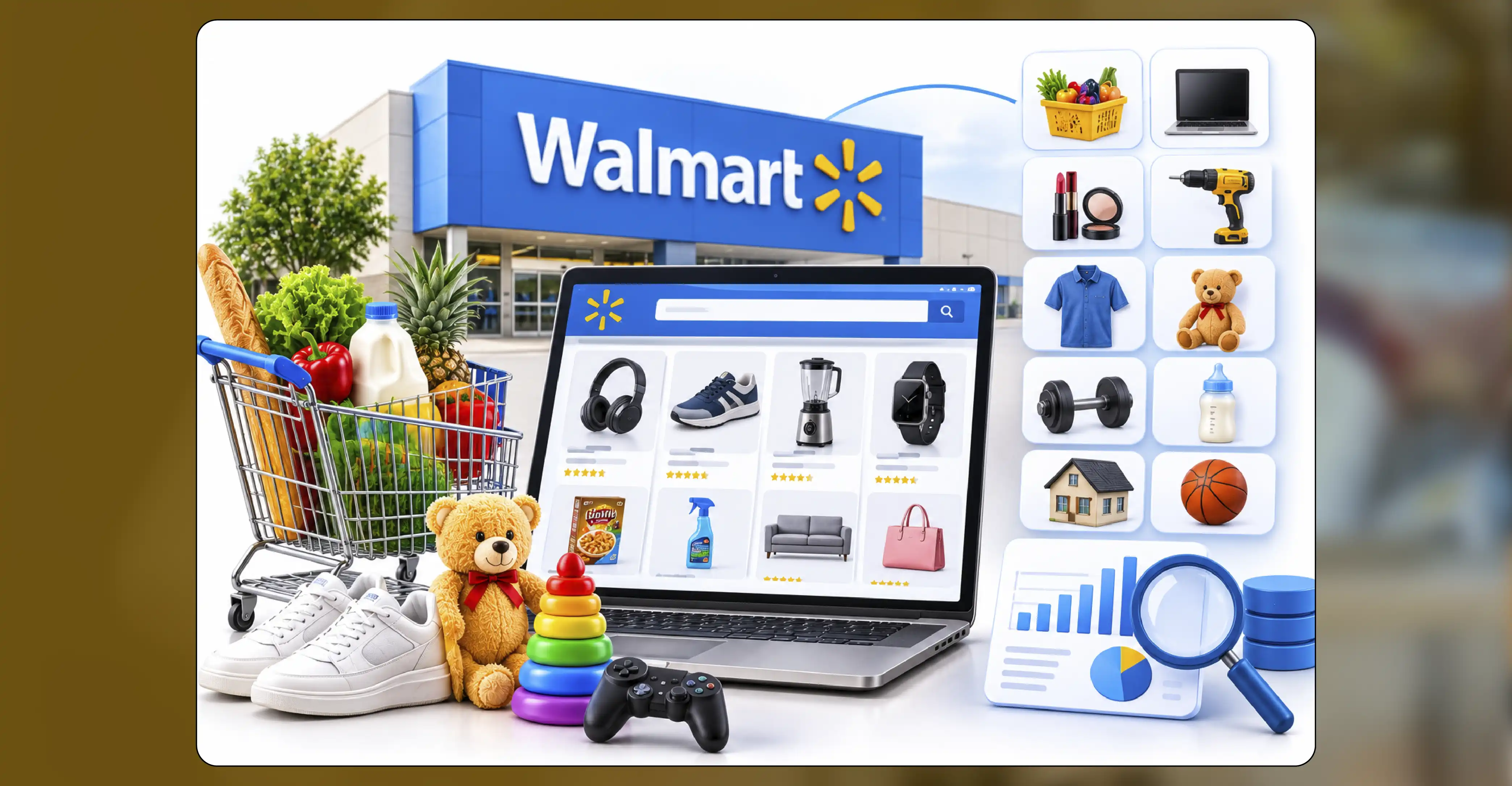
A Walmart product dataset is a structured collection of information extracted from publicly accessible product listings and other permitted retail data sources. It organizes individual product records into consistent fields that businesses can analyze using spreadsheets, databases, business intelligence platforms, and analytics applications.
The dataset can cover multiple departments, including:
- Grocery and packaged food
- Electronics and consumer technology
- Beauty and personal care
- Home improvement and furniture
- Clothing, footwear, and accessories
- Toys, games, and entertainment
- Health and wellness
- Household essentials
- Sports and outdoor equipment
- Baby products and accessories
Each record represents a product or offer, depending on the collection methodology. Retailers can combine these records with historical observations to develop a broader understanding of product assortment, pricing movements, and competitive positioning.
Importantly, Walmart's official Marketplace APIs provide seller-catalog information, while public-facing retail product research may require a separate collection approach. These datasets should not be treated as identical because their coverage and available fields can differ.
2. What's Inside a Walmart Product Dataset?
The actual fields depend on the source, collection frequency, category, and available product information. However, a well-designed retail dataset can contain several important information groups.
A. Product Identification Information
Product identification fields help businesses distinguish individual products, variations, and listings.
Common attributes include:
- Walmart item ID
- Product title and description
- SKU or seller SKU
- UPC and GTIN
- Brand and manufacturer
- Model number
- Product type
- Product URL
These identifiers are particularly important when comparing similar products across different retailers. UPC and GTIN matching can help analysts connect product records and reduce duplicate entries.
B. Product Category and Classification
Category information explains where a product belongs within Walmart's retail structure.
Typical fields include:
- Department name
- Product category
- Subcategory
- Category breadcrumb
- Product type
- Brand classification
- Product collection
For example, an electronics product might be classified under Electronics, Computers, Laptops, and Gaming Laptops.
This information allows category managers to identify assortment gaps, compare competing brands, and evaluate the number of products available within individual departments.
C. Pricing and Discount Information
Pricing is one of the most valuable components of a retail product dataset.
Depending on listing visibility, collected fields may include:
- Current selling price
- Original or reference price
- Promotional price
- Unit price
- Currency
- Discount percentage
- Price per quantity
- Price observation timestamp
These attributes help businesses distinguish between regular pricing and temporary promotional activity.
For example, a retailer could track the listed price of a particular household appliance every day and identify when its selling price decreases during promotional periods.
Historical observations also help identify recurring discount patterns, promotional intensity, and competitor price movements.
D. Product Availability and Fulfillment
Product availability influences purchasing decisions and directly affects competitive positioning.
A structured dataset may include:
- In-stock or out-of-stock status
- Availability information
- Shipping eligibility
- Delivery estimates
- Pickup availability, where displayed
- Fulfillment method
- Shipping charges, where available
Retail teams can use these attributes to understand whether competitive products remain accessible to customers.
Availability monitoring is especially useful during seasonal shopping periods, major promotional events, and periods of changing consumer demand.
E. Product Specifications and Attributes
Product specifications help shoppers compare similar products based on functionality, quality, and features.
Examples include:
- Dimensions and weight
- Color and material
- Size and capacity
- Technical specifications
- Ingredients and nutritional information
- Packaging details
- Warranty information
- Compatibility information
For example, electronics retailers can compare laptop processors, memory, storage, and screen sizes. Grocery businesses can examine package sizes, ingredients, and nutritional attributes.
Standardizing these fields makes product comparisons more meaningful and supports advanced assortment analytics.
F. Ratings, Reviews, and Seller Information
Where publicly visible and permitted for collection, additional product intelligence can include:
- Average customer rating
- Total review count
- Review information
- Seller name
- Seller type
- Product images
- Promotional badges
These attributes help businesses understand product reputation and marketplace competition.
Combining ratings with pricing information can also reveal interesting patterns. For example, analysts may discover that certain premium products maintain higher prices despite having fewer reviews than competing alternatives.
3. Understanding Walmart SKU Data and Product Variations
A product catalog can contain several listings representing different sizes, colors, configurations, and packaging options.
Walmart SKU data helps retail teams distinguish individual sellable products and connect related product variations.
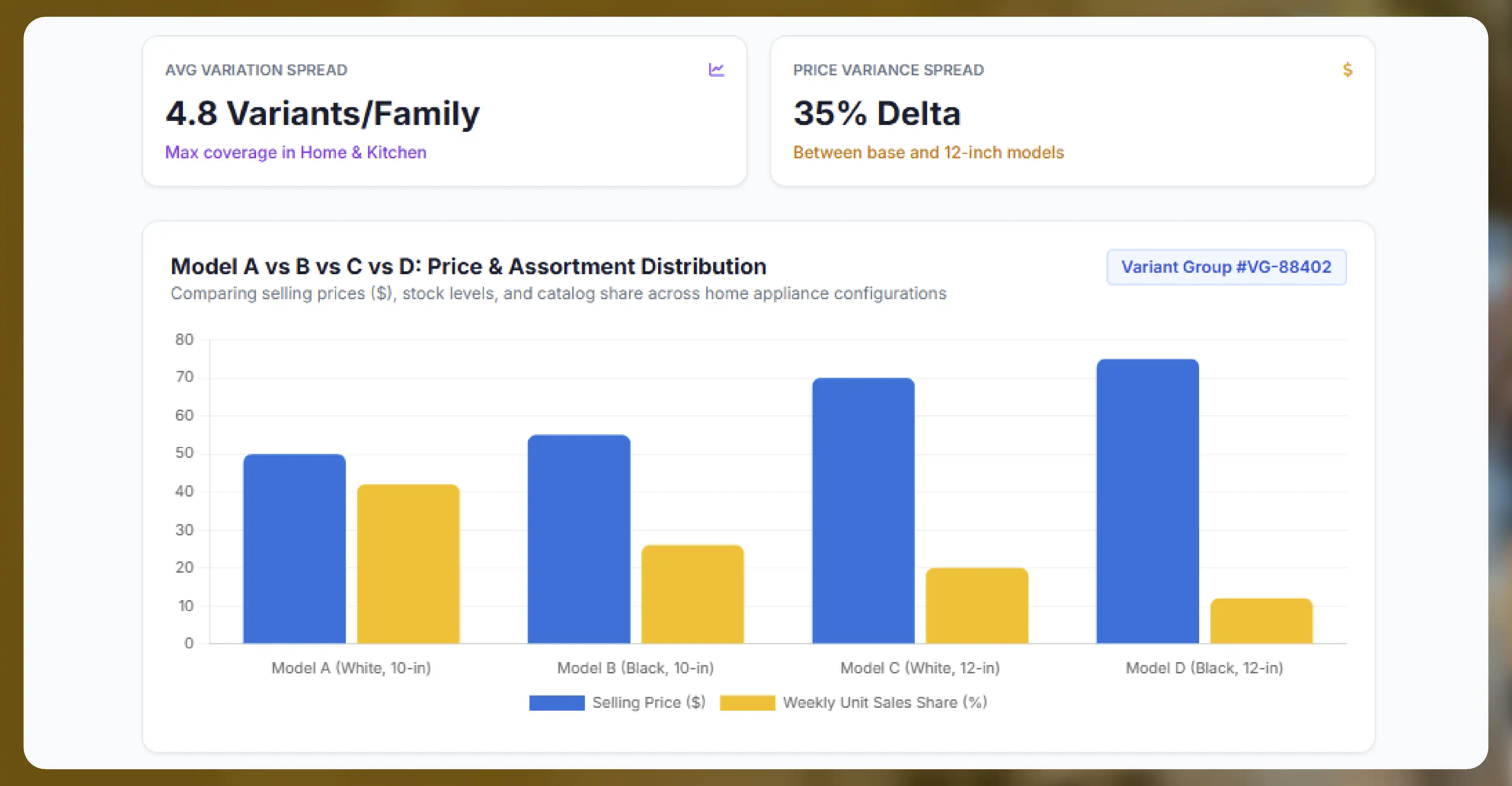
Consider a basic example involving a home appliance. A single product family might include:
| Product Variation | Example Attribute |
|---|---|
| Model A | White, 10-inch |
| Model B | Black, 10-inch |
| Model C | White, 12-inch |
| Model D | Black, 12-inch |
Although these products belong to the same family, their prices, specifications, and availability may differ.
Analyzing variations helps businesses understand which configurations receive greater assortment coverage and where competitors concentrate their offerings.
Walmart's Marketplace documentation also describes variant group identifiers and grouping attributes, including characteristics such as color and size. This makes variant relationships particularly relevant when organizing seller-catalog information.
4. How Retail Teams Use Walmart Product Data for Pricing Intelligence?
Pricing decisions require more than knowing what competitors charge today. Retailers need historical observations, product matching, category-level comparisons, and promotional context.
Competitor Price Benchmarking
Retail teams compare equivalent products across Walmart and competing retailers to understand their market positioning.
For example, an electronics brand can compare the prices of matching televisions, headphones, or laptops across multiple retail platforms.
This helps identify whether its products are priced above, below, or close to competing offers.
Dynamic Pricing Analysis
Historical price observations help businesses recognize changing market conditions.
Retail analysts can monitor price fluctuations, compare promotional periods, and evaluate competitor adjustments.
This information supports more informed pricing decisions instead of relying on occasional manual checks.
Discount and Promotion Tracking
Promotional campaigns can significantly influence product visibility and sales opportunities.
Retailers can analyze original prices, promotional prices, and discount percentages to understand:
- Which categories receive frequent discounts.
- Which brands offer deeper promotions.
- How competitors change prices during seasonal events.
- Which products maintain stable prices.
- Where promotional opportunities exist.
Price Positioning by Category
Different categories require different pricing strategies.
For example, grocery products may compete heavily on unit prices, while electronics products require comparisons involving specifications, models, and product configurations.
Category-level analysis helps businesses establish more appropriate pricing benchmarks.
5. How Retail Teams Use Walmart Catalog Data for Assortment Planning?
Pricing is only one part of retail competitiveness. Product assortment determines what customers can discover and purchase.
Walmart catalog data helps businesses understand product variety, brand representation, category coverage, and product positioning.
Identifying Assortment Gaps
Retailers can compare their existing product selections against Walmart's available assortment.
If competitors offer several variations of a product while a retailer stocks only one, the difference may indicate an opportunity to expand its selection.
Brand Performance Comparison
Category managers can examine the number of listed products associated with different brands.
This helps identify:
- Brands with extensive catalog coverage.
- Emerging brands entering established categories.
- Categories dominated by a small number of manufacturers.
- Product segments with limited brand diversity.
New Product Identification
Monitoring newly observed listings can help businesses identify product launches, expanding categories, and changes in competitive offerings.
A consistent historical dataset makes it easier to distinguish genuinely new listings from products that were previously unavailable or temporarily missing.
Seasonal Assortment Planning
Consumer preferences change throughout the year.
For example, retailers may observe increased assortment activity around back-to-school shopping, summer outdoor activities, holiday gifting, and winter household requirements.
Historical product observations can help merchandising teams plan category coverage ahead of these periods.
6. Why US Retail Product Dataset Analysis Matters?
A broader US retail product dataset provides context beyond one marketplace.
Retailers often need to understand how products are positioned across multiple e-commerce platforms and how competitive conditions differ between retailers.
Combining Walmart product information with other permitted retail sources can help businesses evaluate:
- Cross-retailer price differences.
- Product availability across platforms.
- Brand assortment distribution.
- Category-level competition.
- Promotional pricing strategies.
- Product launches and assortment expansion.
- Differences in product specifications and packaging.
For example, a consumer goods manufacturer can compare its products across Walmart and other major US retailers to identify pricing inconsistencies and assortment opportunities.
The important requirement is accurate product matching. Similar product titles do not always represent identical products. Matching should consider identifiers, brand, model, size, packaging, and product specifications.
7. How to Build and Maintain a Walmart Product Dataset?
Building a useful dataset requires a structured collection and data-processing workflow.
Step 1: Define the Collection Scope
Identify relevant departments, product categories, brands, and attributes. A focused collection strategy helps avoid unnecessary records and keeps the dataset aligned with business objectives.
Step 2: Collect Product Information
Use authorized APIs, permitted public data sources, or suitable data collection infrastructure to retrieve relevant product information. Respect applicable access restrictions, terms, and collection requirements.
Step 3: Standardize Product Records
Normalize product titles, brand names, identifiers, prices, categories, and measurement units. Consistent formatting makes product comparisons easier.
Step 4: Remove Duplicates
Identify repeated listings, duplicate records, and product variations. Preserve meaningful differences between individual sellable items.
Step 5: Validate Data Quality
Check missing attributes, unusual price values, inconsistent identifiers, and incomplete product specifications.
Step 6: Maintain Historical Records
Store timestamped observations rather than replacing previous records. This creates a historical reference for monitoring pricing, availability, and assortment changes.
Step 7: Integrate with Analytics Platforms
Connect structured records with dashboards, spreadsheets, databases, and reporting systems to make insights accessible to pricing, merchandising, and category management teams.
8. Challenges in Walmart Product Data Collection
Although retail datasets offer significant opportunities, collecting and maintaining reliable information requires careful planning.
- Changing Product Listings: Product titles, specifications, categories, and prices may change frequently, making continuous monitoring important.
- Product Matching Difficulties: Similar products may have different identifiers, packaging sizes, or configurations. Accurate matching is essential for meaningful comparisons.
- Incomplete Attributes: Certain listings may not display every specification, seller detail, or availability field. Missing values should be handled transparently.
- Promotional Price Changes: Temporary discounts can create misleading comparisons when historical prices and promotional periods are not properly distinguished.
- Large-Scale Data Management: Tracking thousands of products requires efficient storage, pagination, validation, and processing systems.
- Data Consistency: Different sources may use different category structures, measurement units, and naming conventions. Standardization helps maintain analytical accuracy.
9. How iWeb Data Scraping Can Help You?
iWeb Data Scraping helps businesses transform scattered Walmart retail product information into organized, analysis-ready datasets.
1. Product Catalog Extraction
iWeb Data Scraping collects structured product information, including titles, brands, categories, specifications, and identifiers, helping retailers organize large catalogs for efficient assortment analysis.
2. Competitive Price Monitoring
Track regular prices, promotional offers, unit prices, and historical changes across selected Walmart products to identify competitor movements and support informed pricing strategies.
3. Assortment Intelligence
Analyze product variations, category coverage, brand representation, and newly listed items to identify assortment gaps and discover opportunities for expanding retail product selections.
4. Availability Tracking
Monitor publicly displayed stock indicators and fulfillment information to understand product availability changes, identify potential supply gaps, and evaluate competitive positioning across retail categories.
5. Customized Retail Dashboards
Integrate validated datasets into customized dashboards, spreadsheets, and analytics platforms, enabling pricing teams and merchandising professionals to access organized retail intelligence.
Conclusion
Retail competitiveness increasingly depends on accurate product information, consistent pricing intelligence, and effective assortment planning. A well-structured Walmart product dataset provides businesses with valuable visibility into product categories, brand coverage, prices, discounts, specifications, and availability.
By analyzing historical observations and combining marketplace information with broader retail intelligence, businesses can identify competitive pricing gaps, evaluate product positioning, and improve merchandising decisions.
For organizations focused on price monitoring USA, structured Walmart data can support continuous competitor benchmarking, promotional analysis, and category-level pricing strategies.
iWeb Data Scraping helps businesses transform scattered retail product information into organized, analysis-ready datasets that support smarter pricing decisions, stronger assortment strategies, and data-driven retail growth.
Frequently Asked Questions (FAQs)
It can contain product titles, item IDs, SKUs, UPCs, GTINs, brands, categories, prices, discounts, specifications, availability, ratings, reviews, seller information, and product URLs, depending on source coverage.
Retailers use it for competitor price benchmarking, assortment planning, product matching, brand analysis, discount tracking, availability monitoring, and identifying opportunities for category expansion.
Yes. By storing timestamped product observations, businesses can compare prices over time, identify promotional patterns, measure price fluctuations, and evaluate competitor pricing strategies.
SKU information helps distinguish individual products and variations, reducing duplicate comparisons and allowing retailers to evaluate assortment coverage across different sizes, colors, models, and configurations.
Yes. iWeb Data Scraping can develop customized retail datasets based on selected categories, brands, product attributes, pricing fields, collection frequency, and business requirements.