

KEY TAKEAWAYS
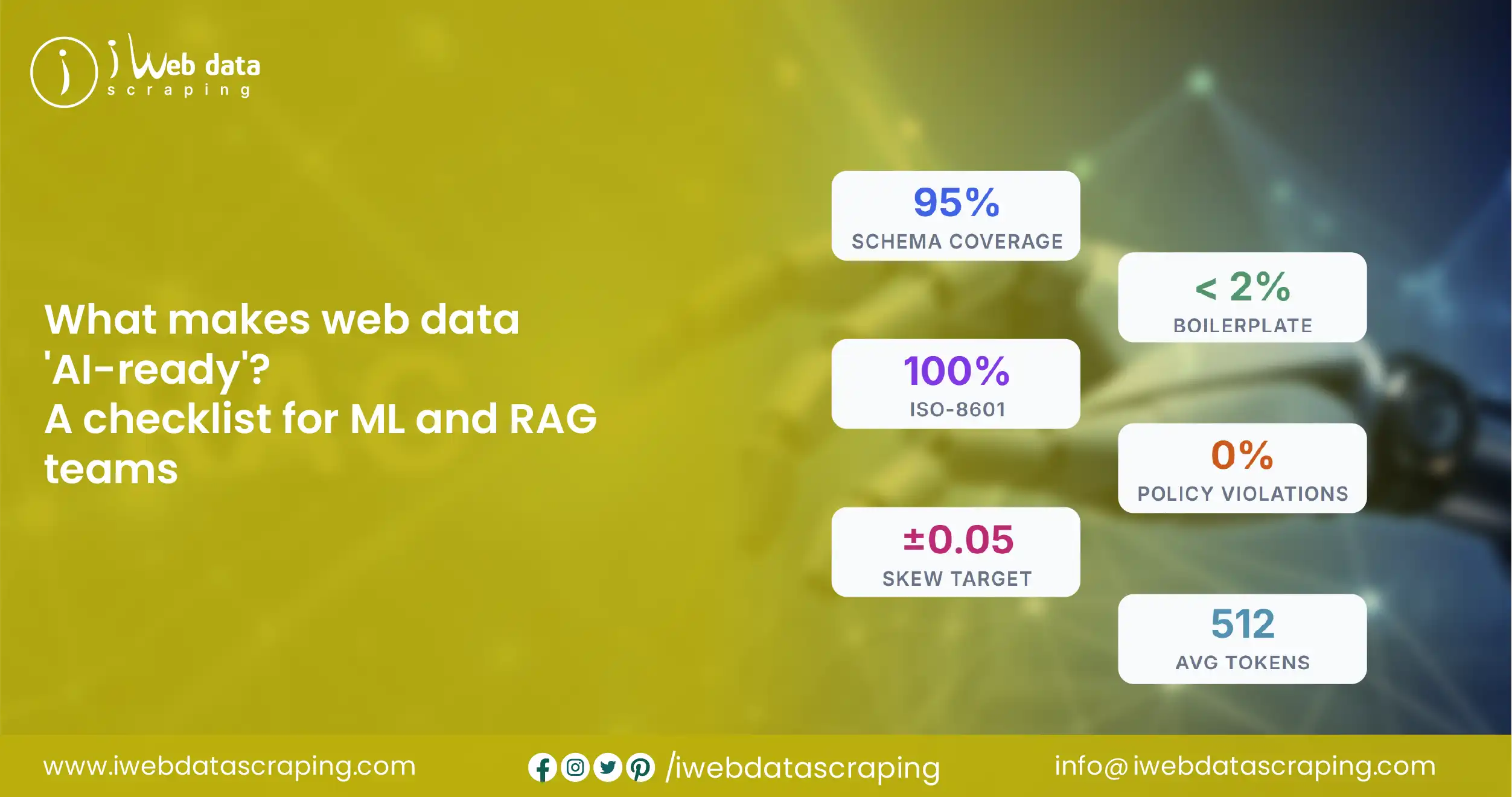
- "AI-ready" is a checklist, not a vibe: deduplicated, structured, PII-scrubbed, provenance-documented, freshness-guaranteed.
- Training corpora and RAG feeds need opposite optimizations — bulk and lineage for one, freshness and chunking for the other.
- Since August 2025, the EU AI Act makes source documentation a legal requirement for general-purpose AI — undocumented crawl dumps are now a liability, not a shortcut.
- The fastest QA test of any data vendor: ask for the dedup rate, PII policy and per-source lineage of a sample. Silence is your answer.
What "AI-ready" actually means
AI-ready data is web data that can go into a training run or a retrieval pipeline without a cleanup project first. Concretely, it satisfies five properties: it is deduplicated (near-duplicates removed, not just exact copies), consistently structured (one schema, validated types, no format drift between batches), PII-scrubbed (personal identifiers removed at collection), provenance-documented (you can say where every record came from and when), and freshness-defined (a stated refresh SLA rather than "recently crawled").
The term matters because the gap between a crawl and a corpus is where AI projects lose their first quarter. Raw web data arrives duplicated, inconsistently encoded, salted with personal data and legally undocumented — and every one of those defects surfaces later as a model problem, a compliance problem, or both.
The five-point checklist, in practice
1. Deduplication — the silent quality multiplier
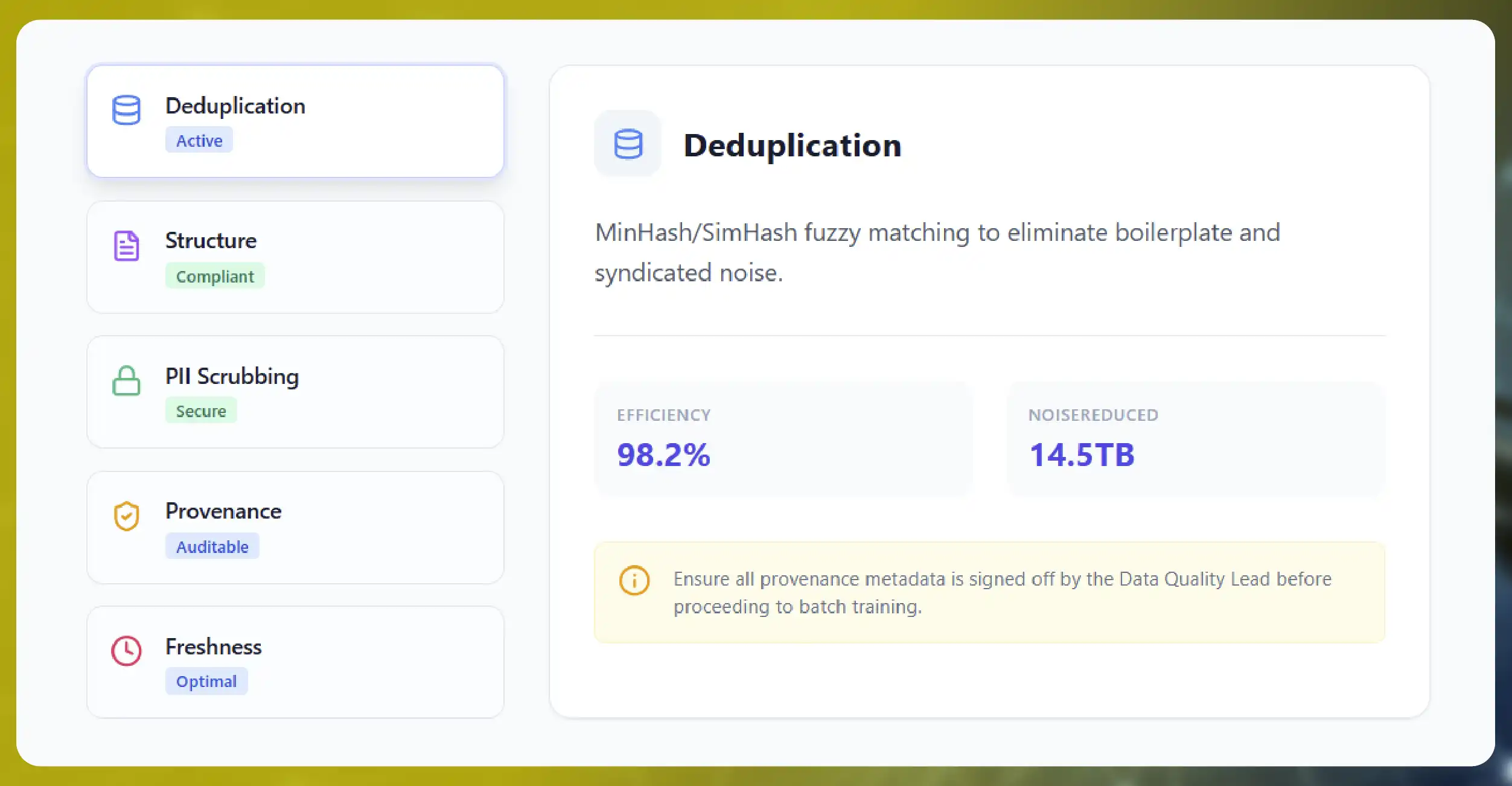
The web repeats itself: templates, mirrors, syndicated listings, boilerplate. Feeding duplicates to a model wastes compute and biases it toward repeated content, which is why serious corpus preparation runs near-duplicate detection (MinHash/SimHash-style fuzzy matching), not just URL dedup. When we deliver training corpora, the dedup report ships with the data — the rate itself tells you how noisy the source was.
2. Structure — one schema, enforced
"Structured" means more than JSON. It means the price field is always a number in a declared currency, availability comes from a closed vocabulary, timestamps carry timezones, and batch 47 has the same schema as batch 1. Schema drift between deliveries is the most common defect we see in datasets teams bring us for rescue.
3. PII scrubbing — at collection, not after
Reviews, Q&A and seller pages leak names, handles, emails and phone numbers. Scrubbing them after ingestion means personal data already transited your systems — a GDPR event in itself. The correct pattern removes identifiers in the extraction pipeline, so the dataset your team touches never contained them.
4. Provenance — now a legal requirement
Under the EU AI Act, providers of general-purpose AI models must publish a sufficiently detailed summary of training content (obligations applicable since August 2025). That's only answerable if every source in your corpus is documented: domain, collection window, method, access basis. One of our AI clients closed an investor diligence question with exactly this paperwork — the case study is here.
5. Freshness — an SLA, not an adjective
For training data, freshness means knowing the collection window so the model's world-knowledge cutoff is intentional. For agents and RAG, it means the feed updates faster than the facts change. A shopping agent quoting yesterday's price isn't slightly stale — it's confidently wrong.
Training data vs RAG feeds: same web, opposite preparation
| Property | Training corpus | RAG / agent feed |
|---|---|---|
| CONSUMED | Offline, in bulk, once per run | At answer time, per query |
| WHAT DOMINATES | Volume, dedup, provenance | Freshness, chunking, retrieval structure |
| FORMAT | JSONL shards, documented splits | Chunked passages + metadata, webhook/API push |
| FRESHNESS | Declared collection window | Minutes to hours, per-field SLA |
| FAILURE MODE | Memorization, bias, legal exposure | Confidently wrong answers in production |
The practical consequence: don't buy one dataset and hope it serves both. Specify the use, and let the preparation follow. Our RAG and agent feeds ship chunked with embedding-friendly metadata and push over webhooks; training corpora ship as documented JSONL with dedup and provenance reports. Same pipeline underneath, different last mile.
Evaluating a data source for your model?
Send one platform and one use case — we'll return a real sample with its dedup rate, schema and provenance sheet, so your team can judge in an afternoon.
How to test any vendor in one email
Ask for a sample plus three artifacts: the deduplication report (method and rate), the PII policy (what's removed, at which pipeline stage), and per-source lineage (domain, window, method, access basis). A vendor doing this work produces all three in a day, because they already exist. A vendor reselling crawl dumps will send you the sample and change the subject.
Then run one adversarial check yourself: take 200 random records and search for exact-duplicate text spans, malformed fields and email-shaped strings. Twenty minutes of scripting tells you more than any sales deck.
The bottom line
"AI-ready" is the difference between data you can use and data you must first survive. The checklist is short — dedup, structure, PII, provenance, freshness — and every item is verifiable from a sample before you spend a rupee or a dollar. Hold vendors to it, including us: the free 48-hour sample exists precisely so the data can make the argument.
Frequently asked questions
AI-ready data is web data prepared for direct use in machine learning and AI applications: deduplicated, consistently structured, PII-scrubbed, documented with source provenance, and — for real-time uses like RAG — delivered fresh enough that the model's answers reflect the current world. A raw crawl dump satisfies none of these by default.
Training data teaches the model patterns and is consumed offline in bulk, so volume, deduplication and provenance dominate. RAG data is retrieved at answer time, so freshness, chunking and retrieval-friendly structure dominate. The same source (say, product pages) needs different preparation for each use.
Duplicated passages cause models to overweight and sometimes memorize repeated content, wasting compute and degrading output diversity. Web crawls are heavily duplicated by nature — mirrors, templates, syndication — so near-duplicate detection is standard preparation before any corpus reaches training.
It depends on what the agent claims to know. Pricing and availability agents need minutes-to-hourly freshness, because a stale answer is a wrong answer with confidence. Research or summarization agents tolerate daily or weekly refresh. Define freshness as an SLA per field, not a vague goal.
At minimum: source domain, collection date, collection method, and licensing/access basis per source — the elements needed to answer the EU AI Act's training-data summary requirement (applicable to general-purpose AI since August 2025). Per-record lineage is stronger and increasingly requested in enterprise and investor due diligence.