
38.9K+
LIVE ORDERS SYNCHRONIZED

Zomato & Swiggy Live Order API Integration for Streamlined Restaurant Operations and Real-Time Multi-Platform Order Management
This case study is designed for restaurant technology teams, multi-brand operators, cloud kitchens, franchise groups, and enterprise food businesses seeking to unify live ordering workflows across Zomato and Swiggy. It examines how a structured integration architecture can connect marketplace orders with restaurant systems, reduce manual intervention, and create a centralized operational layer for order visibility, status updates, menu coordination, and fulfillment intelligence.
It is designed for:
The client's core objective was to eliminate fragmented order handling and establish a reliable integration layer for receiving, normalizing, and routing live marketplace order events into restaurant systems.
A recent enterprise implementation examined how restaurant technology teams can unify marketplace ordering operations through Real-time Swiggy & Zomato order synchronization. The initiative connected incoming order events with restaurant-side workflows, creating a centralized process for order acceptance, preparation, status tracking, cancellation handling, and operational reporting.
The architecture also introduced a Swiggy & Zomato order relay API for restaurants, allowing marketplace order information to move through a standardized integration layer before reaching POS, kitchen display, order management, and analytics systems. Instead of relying on manual order entry or disconnected dashboards, the client established automated data exchange between delivery platforms and internal restaurant applications.
The architecture captured order IDs, outlet information, item details, quantities, prices, discounts, taxes, payment indicators, timestamps, and order status events. Normalization reduced inconsistencies between marketplace schemas.
Structured monitoring covered acceptance time, preparation progress, cancellations, unavailable items, delayed updates, and completion across outlets.
The project also created structured monitoring for acceptance time, preparation progress, cancellations, unavailable items, delayed updates, and order completion. This gave operations teams a more consistent view of live marketplace activity across outlets.
API integration, validation, event processing, and centralized reporting improved order visibility and reduced repetitive tasks, while creating a foundation for broader food delivery analytics.
The client managed a growing restaurant network receiving orders through multiple digital channels. Marketplace orders entered separate workflows, creating inconsistencies in acceptance, preparation tracking, menu availability, and reporting. Staff frequently switched between systems, increasing operational complexity during peak periods.
A major challenge was the absence of a unified live food delivery order API for restaurant chains for consolidating marketplace events. Different structures, statuses, timestamps, and item formats made reconciliation difficult.
The client also explored Zomato and Swiggy data scraping for menu, pricing, availability, and competitive intelligence. Operational order events needed to remain separate from broader marketplace datasets.
Another issue was fragmented menu and availability information. When an item became unavailable at one outlet, restaurant teams needed faster synchronization between internal systems and marketplace-facing information. Manual updates created opportunities for outdated availability and inconsistent customer experiences.
The client required Food Delivery Data Scraping Services to support complementary marketplace intelligence and structured collection of public food delivery information for analytics, benchmarking, and menu intelligence use cases.
Operational teams lacked a unified dashboard for order volumes, acceptance rates, preparation stages, cancellations, and synchronization exceptions.
Peak-hour spikes required the system to process event bursts without duplicates, missed updates, or delayed statuses, making retries and error handling essential.
The client ultimately required scalable architecture for event normalization, restaurant-system connectivity, synchronization monitoring, and future analytics.
By implementing a centralized integration pipeline, the client replaced fragmented marketplace monitoring with automated order ingestion, normalization, validation, and status synchronization. The system created a consistent operational workflow across restaurants, delivery platforms, POS systems, and analytics applications.
| Dimension | Manual Marketplace Handling | Client Integration System |
|---|---|---|
| Order capture | Staff manually monitor multiple dashboards | Automated event-based order ingestion |
| Order entry | Repetitive manual entry into restaurant systems | Structured order transmission |
| Status updates | Updated separately across systems | Automated status synchronization |
| Menu availability | Manual marketplace changes | Centralized availability workflow |
| Data structure | Different formats by platform | Normalized fields and schemas |
| Error handling | Issues discovered after manual review | Automated validation, logging, and retry |
| Reporting | Platform-specific reports | Unified operational dashboard |
| Scalability | Difficult during peak periods | Designed for high-volume event processing |
The brand in focus is a multi-location restaurant organization operating through major food delivery marketplaces while maintaining its own POS, kitchen, inventory, and analytics systems. Its growing digital order volume created a need for tighter coordination between marketplace activity and internal restaurant operations.
As outlets and marketplace transactions increased, manual handling became difficult. Employees monitored orders, acceptance, preparation stages, cancellations, and reconciliation across separate systems, creating delays and inconsistent records.
The organization wanted an event-driven model where marketplace orders entered a centralized integration layer and flowed into approved restaurant applications, creating dependable synchronization.
Structured records could also be aggregated by restaurant, brand, platform, time period, item category, and status, supporting performance analysis and forecasting.
We delivered an end-to-end integration framework designed to connect marketplace order events with restaurant-side systems through structured APIs, normalization, validation, and monitoring.
The first layer focused on ingestion. Incoming order events were captured through supported integration mechanisms and passed into a controlled processing environment. Each event received a unique reference for tracking and reconciliation.
The second layer normalized order ID, outlet ID, item, quantity, price, discount, tax, payment status, timestamps, preparation, cancellation, and delivery states.
The architecture also incorporated Food Delivery App Menu Datasets to support menu-level analytics, item availability tracking, pricing comparisons, and structured marketplace intelligence alongside live operational data.
A reusable Scraping API layer supported permitted supplementary marketplace collection for analytics and benchmarking, separate from the transactional order stream.
The solution also used Mobile app scraping for selected public marketplace intelligence, keeping these datasets separate from transactional integration flows.
Validation rules checked duplicate events, missing fields, invalid timestamps, unexpected status transitions, and outlet mismatches. Failed events entered retry queues and exception logs for controlled recovery.
A centralized monitoring layer displayed order counts, latency, errors, statuses, cancellations, and outlet activity, helping teams identify issues and trace event histories.
The integration created a centralized view of incoming marketplace orders across participating restaurants. Instead of checking separate applications, operations teams could monitor live order activity through a unified system.
Order events were normalized after ingestion, giving restaurant applications consistent information and reducing manual entry.
Each order received a traceable sequence covering arrival, acceptance, preparation, and status changes, improving operational transparency.
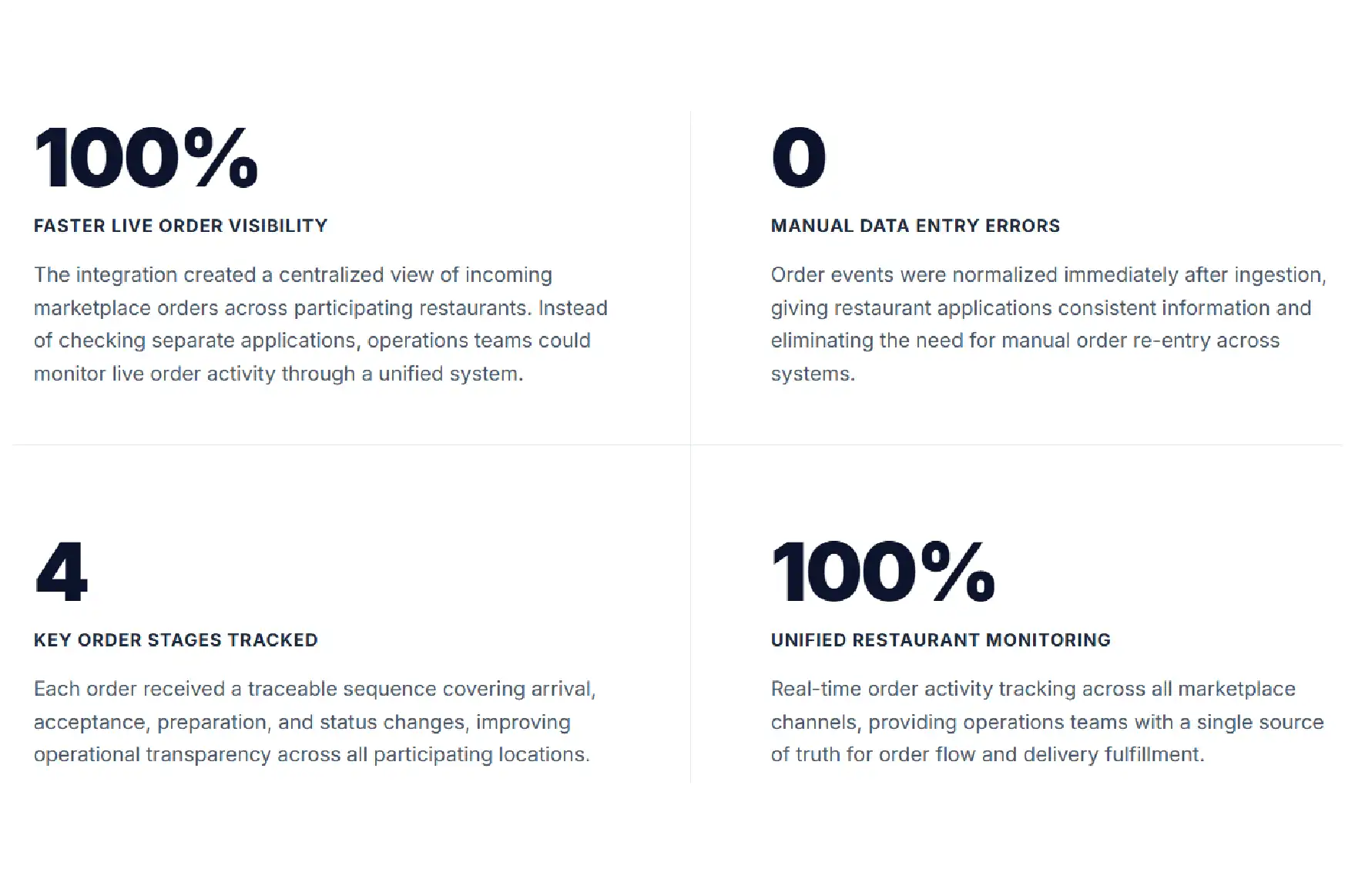
Automated processing improved consistency between marketplace events and restaurant records while reducing missed or duplicate orders.
The system used validation and reconciliation logic to compare event identifiers and status changes. When duplicate or unexpected events appeared, they could be isolated rather than automatically creating conflicting records.
Controlled queues handled peak-period event bursts while preserving an auditable processing record.
| Metric | Insight Captured | Business Impact |
|---|---|---|
| Order Volume | Orders received by platform and outlet | Improved capacity planning |
| Acceptance Rate | Accepted versus received orders | Better operational monitoring |
| Sync Latency | Time between marketplace event and internal update | Faster issue identification |
| Cancellation Rate | Cancelled orders by reason and outlet | Improved exception analysis |
| Item Availability | Available and unavailable menu items | Better menu coordination |
| Status Accuracy | Expected versus received order states | Stronger reconciliation |
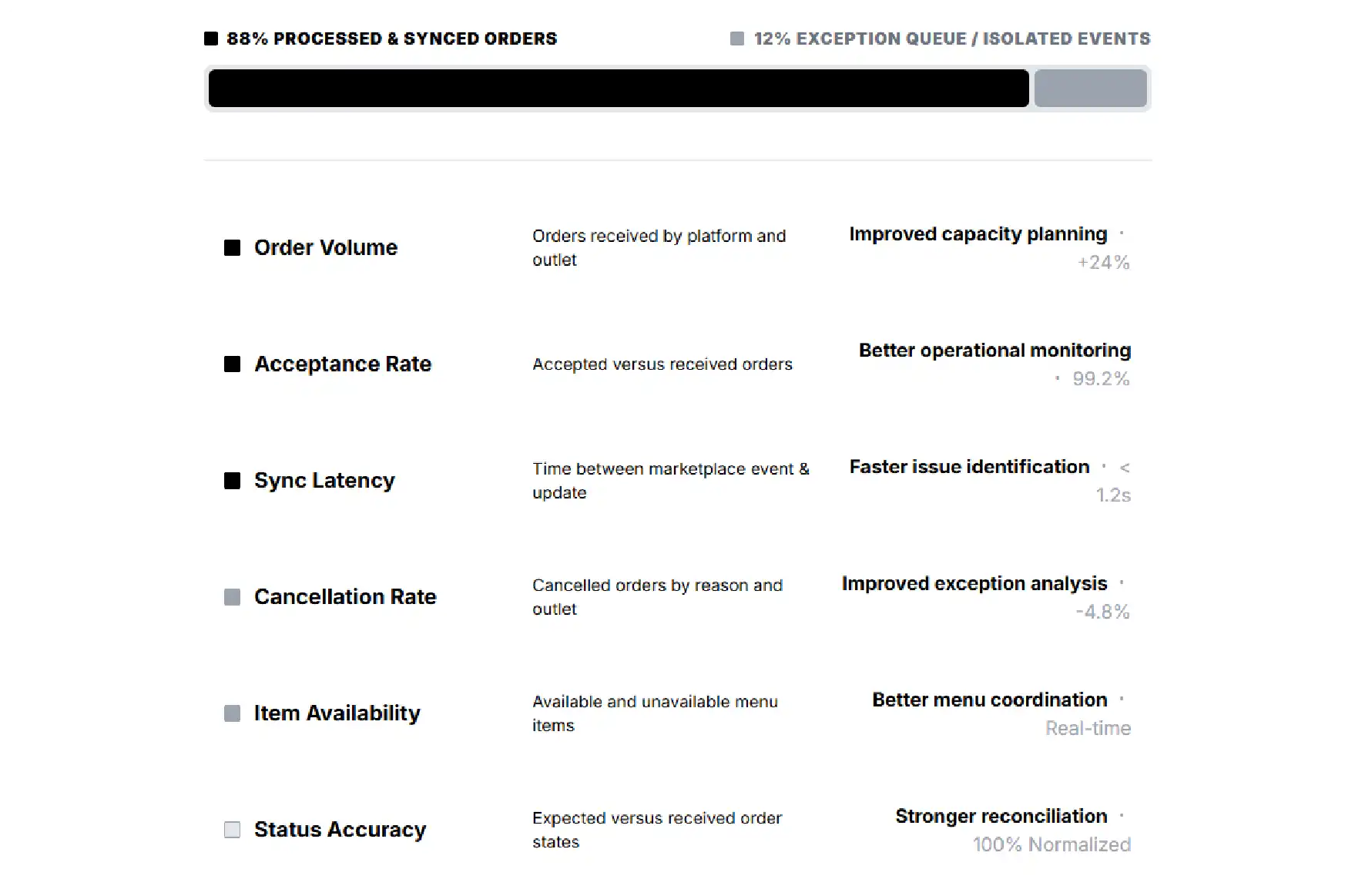
The integration allowed the organization to combine marketplace order activity with internal restaurant workflows. Managers could review platform activity alongside outlet-level operational information without switching continuously between systems.
Centralized records improved reporting consistency by replacing separate marketplace reports with normalized common fields.
Teams could analyze outlet volume, acceptance delays, unavailable items, and cancellation patterns from one dataset.
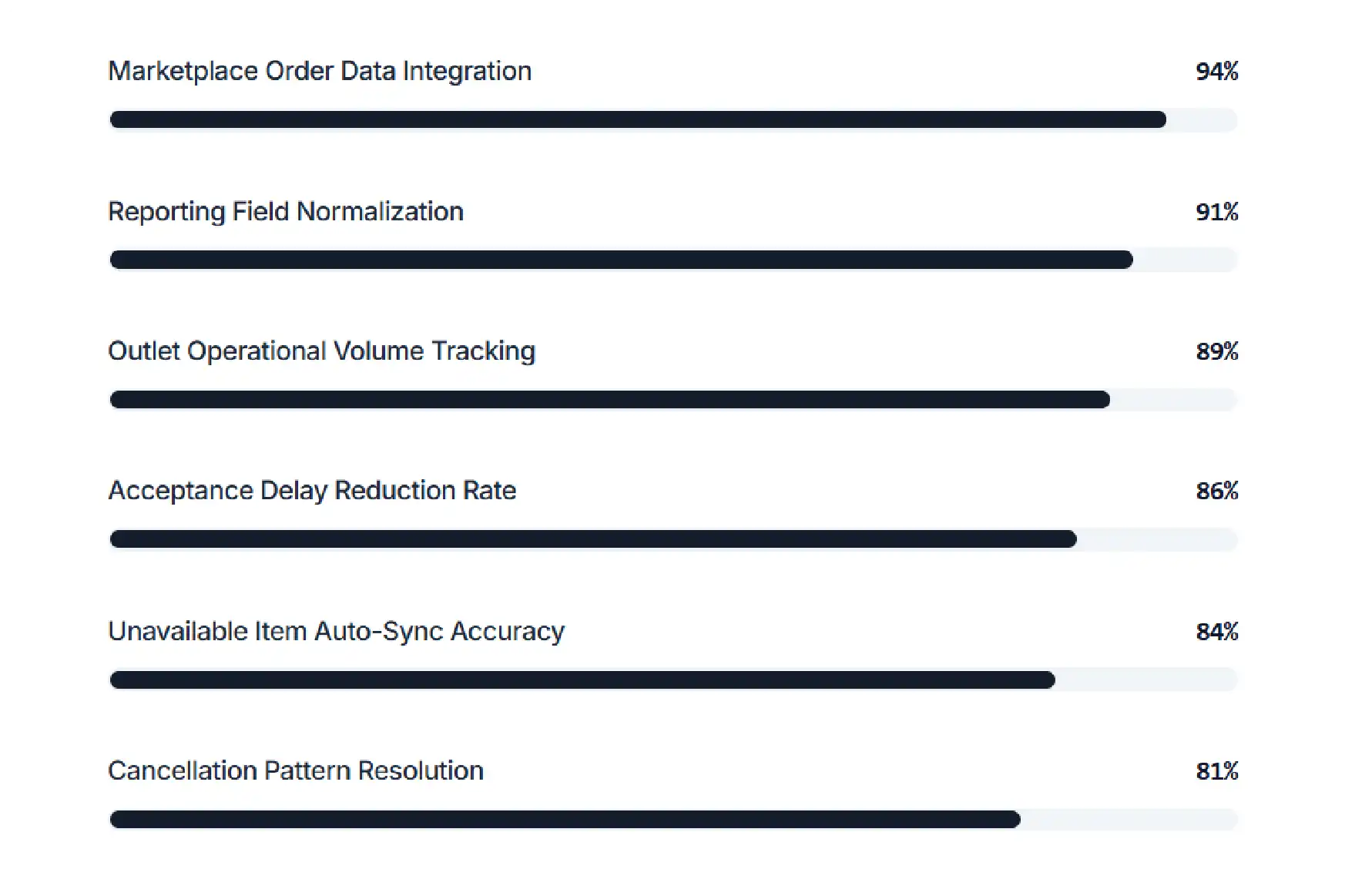
The architecture was designed to support additional outlets, brands, and food delivery channels without rebuilding the entire workflow. Standardized schemas and modular connectors allowed new sources to be incorporated through controlled integration processes.
Because order volume varies by outlet and time, ingestion, processing, validation, storage, and reporting were separated so each layer could scale independently.
The modular design also supports demand forecasting, item performance analysis, delivery-time benchmarking, promotion analysis, and operational alerts.
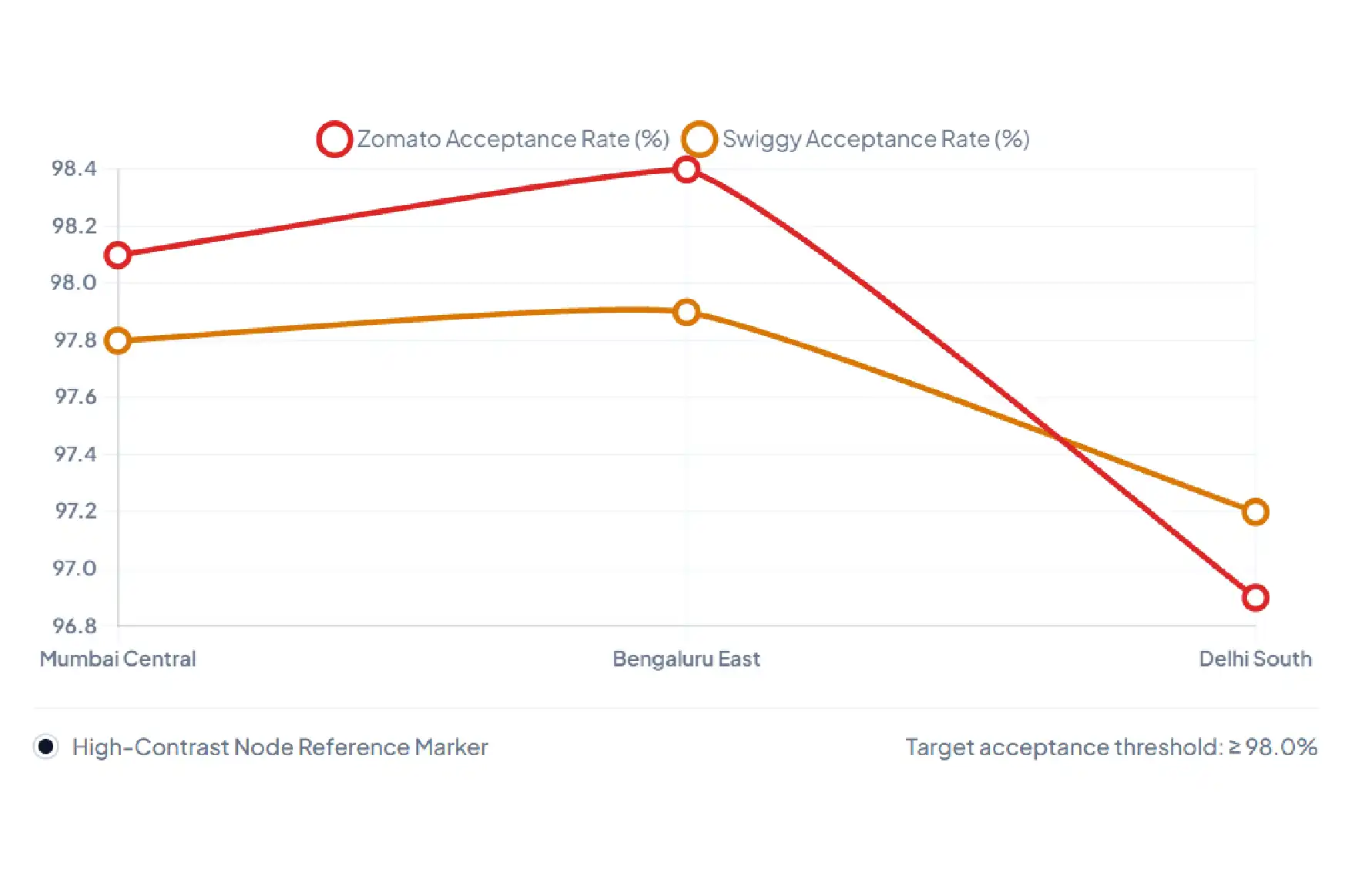
The sample dataset illustrates how normalized live-order information can be organized across restaurant outlets and marketplace channels. It includes order volume, average order value, acceptance rate, synchronization latency, and cancellation rate to demonstrate how operational records can support restaurant intelligence.
| Outlet | Platform | Orders | Avg. Order Value | Acceptance Rate | Sync Latency | Cancellation Rate |
|---|---|---|---|---|---|---|
| Mumbai Central | Zomato | 4,820 | ₹486 | 98.1% | 2.2 min | 2.1% |
| Mumbai Central | Swiggy | 5,140 | ₹472 | 97.8% | 2.4 min | 2.4% |
| Bengaluru East | Zomato | 4,360 | ₹521 | 98.4% | 2.5 min | 1.9% |
| Bengaluru East | Swiggy | 4,610 | ₹508 | 97.9% | 2.7 min | 2.2% |
| Delhi South | Zomato | 3,920 | ₹455 | 96.9% | 2.8 min | 2.8% |
| Delhi South | Swiggy | 4,050 | ₹463 | 97.2% | 2.9 min | 2.6% |
After implementing the structured live-order integration, the client achieved stronger visibility into marketplace activity and reduced operational dependence on manual order handling.
Our approach combines structured data collection, API integration, validation, and analytics workflows to help restaurant businesses create a unified information layer across digital food delivery ecosystems.
The architecture supports centralized collection across multiple marketplace sources, reducing fragmentation between operational and analytical datasets. Normalized schemas make it easier to compare orders, menu information, outlet performance, and platform activity through consistent fields.
The system also supports real-time monitoring by continuously processing incoming events and surfacing synchronization issues. This enables technology and operations teams to identify delays, failed events, and unusual order patterns without waiting for manual reports.
Data quality is strengthened through validation, deduplication, timestamp checks, schema controls, and reconciliation logic. These processes help maintain reliable records for dashboards, analytics, forecasting, and operational reporting.
Scalability is another core advantage. The architecture can be extended across additional outlets and data sources while preserving a consistent processing framework. This supports restaurant groups as digital ordering volumes increase.
Finally, structured food delivery intelligence can support broader business decisions. Historical order data can help organizations understand platform mix, outlet performance, item demand, cancellation behavior, and operational patterns while maintaining a clear distinction between transactional integration and supplementary marketplace intelligence.
We are highly satisfied with the integration delivered by the team. The solution helped us bring marketplace order information into a structured operational workflow and significantly reduced the need for manual monitoring. Our teams now have clearer visibility into live orders, status changes, outlet activity, and synchronization exceptions. The system has also improved reporting consistency and created a stronger foundation for future restaurant analytics. The combination of integration, data processing, and monitoring has made our digital ordering operations more organized and scalable.
—Head of Restaurant Technology
The final outcome was an automated and scalable live-order integration framework connecting marketplace activity with restaurant operational systems. The client gained centralized visibility into orders, statuses, outlet activity, cancellations, menu information, and synchronization performance.
The architecture reduced repetitive manual handling and created standardized records for operational and analytical workflows. Automated validation and reconciliation improved confidence in the consistency of order data while exception logging provided technology teams with a clear mechanism for identifying processing issues.
The solution also supports future outlets, brands, analytics applications, and food delivery sources through modular connectors and common structures.
Implementation of structured API and data processing workflows improved the organization's ability to monitor digital orders at scale. The resulting system supports faster operational reporting, better exception management, and more consistent coordination between marketplace activity and restaurant systems.
Overall, the project transformed fragmented marketplace order flows into a centralized data intelligence environment capable of supporting live operations, structured analytics, and future restaurant technology expansion.
Live order API integration connects supported food delivery marketplace order events with restaurant systems such as POS, kitchen displays, order management platforms, and analytics applications. It helps synchronize order information through structured automated workflows.
Where supported by the relevant platform integration arrangements and technical interfaces, order information can be routed into restaurant systems through a standardized integration architecture. Field mapping and status handling are configured according to the connected systems.
Depending on the available integration and permissions, structured records can include order identifiers, outlet details, item information, quantities, prices, discounts, taxes, timestamps, payment indicators, and order status events.
A structured integration can use unique event or order identifiers, validation rules, reconciliation logic, processing queues, and audit logs to detect duplicate events and prevent them from creating conflicting internal records.
Yes. A modular architecture can use common schemas and outlet identifiers to process orders across multiple locations. This allows restaurant groups to maintain centralized reporting while preserving outlet-level operational visibility.
Our food delivery data integration and intelligence solutions help restaurant businesses connect marketplace order flows with structured operational systems, improve synchronization visibility, reduce manual effort, and build scalable analytics workflows across multiple outlets and digital ordering channels.
Start a projectFields marked * are required. Everything else just helps us scope faster — skip what you don't know yet.