Introduction
Airline pricing has become one of the most dynamic forms of digital commerce. Fares
can change as inventory shifts, demand rises, booking windows narrow, routes become constrained,
or airlines adjust their commercial strategies. For travel brands, static flight datasets are
therefore no longer sufficient for competitive pricing, fare monitoring, or traveler-facing
recommendations.
The Airlines API Real-Time Data Scraping Report 2026 examines how travel businesses
can build structured, continuously refreshed intelligence from airline APIs, NDC connections,
authorized aggregators, GDS platforms, and other permitted aviation-data sources. Modern airline
distribution increasingly supports structured exchange of offers, pricing, availability,
schedules, and ancillary information. IATA describes NDC as a framework designed to improve
access to richer air content and enable more transparent retailing, while airline
implementations can expose shopping and pricing capabilities through standardized API messages.
Track live airline fares using API data to move from periodic fare collection toward
continuous market intelligence. Instead of simply recording a flight price once, an API-driven
system can capture the same route repeatedly and measure how its price, availability, fare
family, baggage allowance, taxes, and booking conditions evolve over time.
Extract
real-time airline API data for travel brands to power airfare comparison engines, travel
applications, revenue-management dashboards, corporate travel platforms, fare-alert systems,
destination analytics, and competitive-intelligence products.
Why Real-Time Airline Data Matters?
Flight pricing is fundamentally time-sensitive. A fare observed at 9:00 a.m. may not
be available at 3:00 p.m. The important intelligence is therefore not merely the current fare,
but the relationship between price, availability, route, departure date, booking window,
airline, cabin, and timestamp.
A mature airline-data pipeline typically captures:
- Airline and flight number
- Origin and destination airports
- Departure and arrival times
- Journey duration
- Non-stop or connecting status
- Cabin class
- Fare family
- Base fare
- Taxes and fees
- Total displayed price
- Currency
- Checked-baggage allowance
- Seat or ancillary availability
- Fare conditions
- Offer identifier
- Search timestamp
- API response status
NDC is particularly important because it enables airline offers to be communicated
more directly through standardized distribution processes. IndiGo, for example, documents
AirShopping, OfferPrice, OrderCreate, OrderRetrieve, and related NDC functions.
This creates an important distinction between flight-status data and commercial
flight-offer data. Operational APIs can provide schedules and status events, while shopping APIs
can provide fares and availability. OAG, for example, currently documents APIs for flight
information and alerts, including HTTP push delivery for schedule and status changes.
Flight Pricing Intelligence Using Airline API Data
The most valuable output of an Flight pricing intelligence using airline API data is
not a raw stream of JSON or XML responses. It is a historical intelligence layer created after
normalization, deduplication, enrichment, and time-series analysis.
Suppose a travel company monitors 500 routes every 30 minutes. A single observation
might reveal that a Delhi–Dubai fare is ₹18,400. Historical observations could reveal something
more valuable: the same route averaged ₹15,900 seven days earlier, inventory has fallen from 9
seats to 4 seats, and the fare premium has increased by 15.7%.
That difference transforms raw API data into commercial intelligence.
Travel brands can calculate:
- Minimum observed fare
- Median fare
- Average fare
- Fare volatility
- Price movement percentage
- Availability changes
- Cabin-level price gaps
- Advance-purchase pricing
- Airline price competitiveness
- Route-level demand indicators
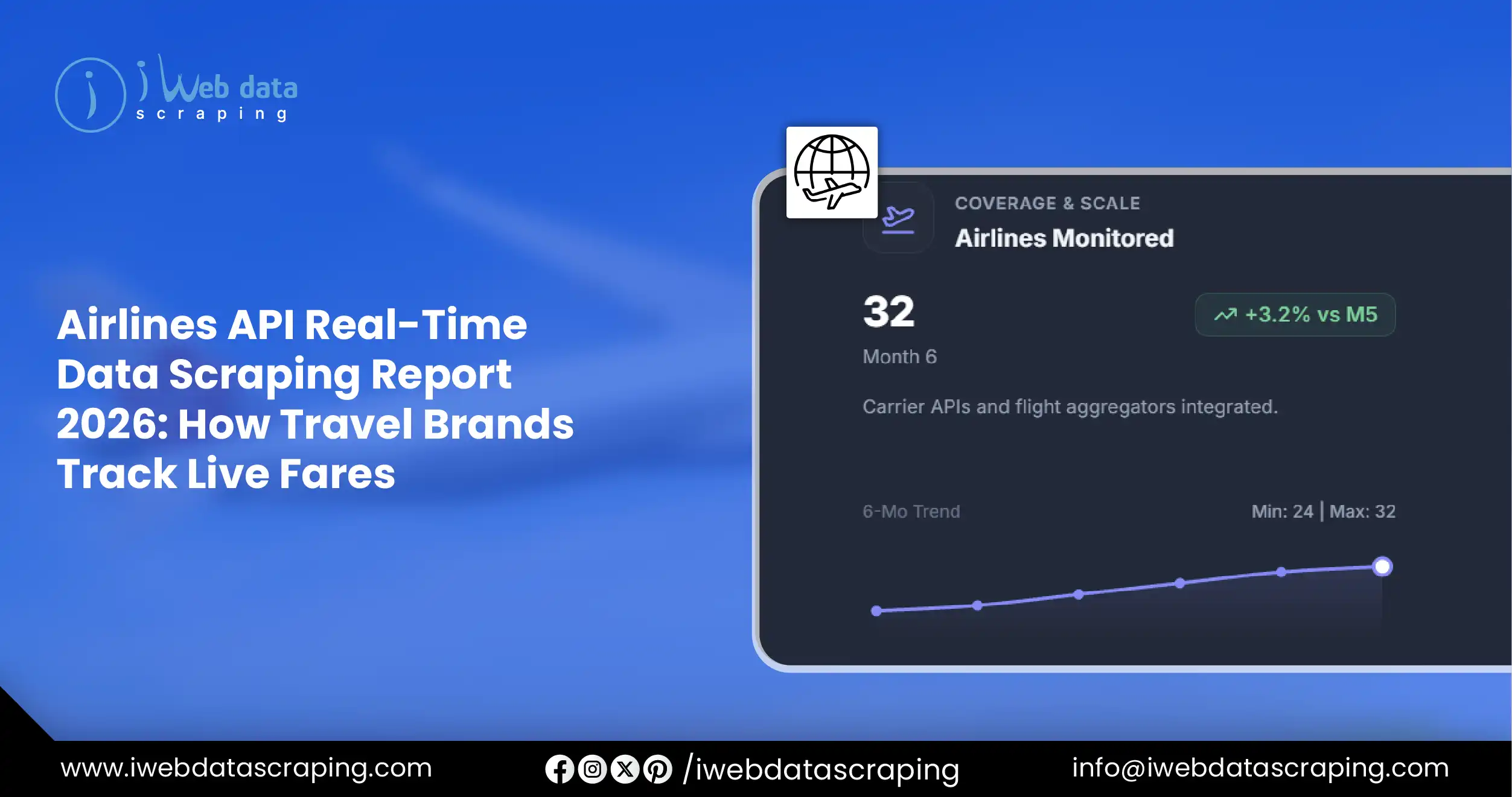
Illustrative six-month monitoring benchmark
| Routes monitored |
500 |
500 |
575 |
575 |
650 |
650 |
| Airlines monitored |
24 |
25 |
27 |
29 |
31 |
32 |
| Daily API searches |
18,000 |
21,000 |
24,000 |
27,500 |
31,000 |
35,000 |
| Monthly observations |
540,000 |
630,000 |
720,000 |
825,000 |
930,000 |
1,050,000 |
| Average fare, ₹ |
12,850 |
13,120 |
12,640 |
13,480 |
13,910 |
14,260 |
| Median fare, ₹ |
11,900 |
12,100 |
11,750 |
12,450 |
12,850 |
13,100 |
| Lowest observed fare, ₹ |
3,950 |
3,780 |
3,620 |
3,850 |
3,690 |
3,550 |
| Average availability |
8.4 |
8.1 |
7.8 |
7.3 |
6.9 |
6.5 |
| Price-change events |
84,200 |
96,500 |
108,300 |
126,400 |
149,700 |
171,900 |
| Fare volatility index |
6.8% |
7.1% |
7.4% |
8.2% |
8.7% |
9.1% |
| Average response time, ms |
820 |
805 |
790 |
775 |
760 |
748 |
| Successful API responses |
97.4% |
97.7% |
98.0% |
98.1% |
98.3% |
98.5% |
The figures above are an illustrative analytical benchmark, not reported
airline-market measurements.
The table demonstrates why longitudinal collection is valuable. A travel brand can
monitor not only the fare itself but also the rate at which the market changes.
Real-Time Airline Data Collection for Travel Brands
A scalable Real-time airline data collection for travel brands architecture
generally has five layers.
Layer 1: Data acquisition
Authorized APIs, NDC connections, GDS feeds, aggregators, and aviation-data
providers supply source information. IATA maintains standards and API-related specifications
covering passenger distribution and aviation operations.
Layer 2: Normalization
Different providers may represent the same concept differently. One source may
return totalAmount, another total_price, while another uses a nested offer structure.
Normalization converts these into consistent fields.
Layer 3: Validation
The pipeline should verify currency, timestamps, airport codes, flight identifiers,
fare totals, cabin categories, and availability values. Invalid responses should be isolated
rather than polluting historical datasets.
Layer 4: Storage
Time-series databases, cloud warehouses, object storage, or relational databases can
preserve snapshots. Each observation should retain its collection timestamp so analysts can
reconstruct the market as it appeared at a particular moment.
Layer 5: Analytics
The final layer converts observations into dashboards, alerts, forecasts,
competitive comparisons, and customer-facing recommendations.
Scrape Airline API for Fare and Availability Data
In practical deployments, the phrase Scrape Airline API for fare and availability
data should not mean bypassing authentication, defeating technical controls, or ignoring
provider terms. The sustainable approach is to collect data through APIs, NDC connections,
licensed aggregators, or other authorized interfaces.
This distinction becomes especially important at scale. Airline APIs can enforce
authentication, rate limits, request quotas, caching rules, and commercial-access policies.
IATA's API guidance specifically discusses authentication, key management, usage limits,
throttling, caching, telemetry, and API governance.
For example, a travel brand might configure collection around:
- 15-minute updates for priority routes
- 30-minute updates for high-volume routes
- 2-hour updates for long-tail routes
- Daily historical snapshots for slower-moving datasets
The correct frequency depends on the business objective and supplier rules.
Building a Connected Airline Intelligence Pipeline
API collection becomes significantly more powerful when multiple data dimensions are
joined. Rather than analyzing airfare as an isolated metric, travel brands can build a connected
intelligence layer that combines pricing, availability, schedules, route information, and
operational signals.
A well-designed system can Scrape airline data API sources through authorized
interfaces and transform the responses into standardized datasets suitable for historical
analysis and real-time monitoring.
A fare dataset can be combined with:
- Airport schedules
- Flight-status events
- Route networks
- Historical fares
- Holiday calendars
- Weather information
- Airport congestion
- Destination demand
- Currency exchange rates
- Hotel prices
- Search-volume trends
This creates a broader travel-intelligence environment rather than a standalone
airfare database.
Example route intelligence dataset
| DEL–DXB |
IndiGo |
Economy |
18,450 |
12,990 |
29,800 |
6 |
8.4 |
4,850 |
1,920 |
| BOM–SIN |
Singapore Airlines |
Economy |
22,780 |
16,450 |
34,900 |
5 |
11.2 |
3,920 |
1,640 |
| BLR–LHR |
British Airways |
Economy |
48,600 |
39,800 |
67,500 |
4 |
14.7 |
2,840 |
1,280 |
| DEL–LHR |
Air India |
Business |
142,800 |
119,500 |
198,000 |
3 |
18.6 |
1,760 |
940 |
| MAA–SIN |
Air India Express |
Economy |
17,250 |
11,900 |
26,700 |
7 |
7.8 |
3,110 |
1,520 |
| HYD–DXB |
Emirates |
Economy |
15,980 |
10,850 |
23,900 |
6 |
9.1 |
2,980 |
1,410 |
| CCU–BKK |
Thai Airways |
Economy |
19,640 |
14,200 |
28,500 |
5 |
10.5 |
2,260 |
1,170 |
| BOM–SYD |
Qantas |
Economy |
61,300 |
49,900 |
88,400 |
4 |
16.3 |
1,920 |
1,060 |
| DEL–FRA |
Lufthansa |
Premium Economy |
54,700 |
42,600 |
79,300 |
5 |
13.4 |
2,140 |
1,130 |
| BLR–CDG |
Air France |
Economy |
46,850 |
36,900 |
69,800 |
4 |
15.2 |
1,870 |
980 |
| BOM–NYC |
Qatar Airways |
Economy |
72,400 |
58,500 |
109,900 |
3 |
19.5 |
2,630 |
1,350 |
| DEL–SIN |
Vistara |
Economy |
24,900 |
18,700 |
37,800 |
5 |
12.8 |
2,450 |
1,260 |
Illustrative benchmark data created for analytical demonstration.
Travel & Tourism App Datasets
The growing sophistication of travel applications is increasing demand for
structured, continuously updated datasets. A modern travel application may need to combine
flight fares with hotels, transfers, destinations, airport information, reviews, baggage rules,
schedules, and other travel attributes.
This means Travel & Tourism App
Datasets is becoming one component of a much broader travel-data architecture.
For example, an app could calculate a complete trip score using:
- Flight price + baggage cost + hotel price + transfer time + departure
convenience + cancellation conditions.
Such calculations are difficult when the underlying data is static. Real-time API
feeds make it possible to refresh the underlying variables as market conditions change.
Business Applications
The commercial applications extend well beyond flight comparison.
- Travel marketplaces can rank offers according to price and convenience.
- Corporate travel platforms can identify fare changes and policy-compliant
alternatives.
- Travel agencies can monitor competitor pricing and improve quote accuracy.
- Airline partners can evaluate distribution performance.
- Metasearch platforms can detect significant price movements and refresh search
results.
- Revenue teams can benchmark fares across routes, cabins, competitors, and
booking windows.
- Marketing teams can trigger fare alerts when a monitored route falls below a
predefined threshold.
A mature system can therefore transform millions of API observations into a small
number of actionable alerts.
Key Challenges in Real-Time Airline Data
Real-time collection is not simply a matter of increasing API calls.
The first challenge is rate management. Excessive requests can increase costs and
potentially violate supplier policies.
The second is data consistency. Different sources can return different fare
structures, currencies, baggage information, or availability states.
The third is offer volatility. A search result does not necessarily guarantee that
the same offer remains available later. NDC systems can provide pricing confirmation through
dedicated offer-pricing processes, highlighting the distinction between an initial shopping
response and later price confirmation.
The fourth is latency. A technically accurate API that responds too slowly can
reduce the usefulness of a consumer-facing search product.
The fifth is historical reconstruction. Without timestamped snapshots, brands cannot
reliably measure how fares changed.
Finally, commercial authorization and compliance must remain central. Travel brands
should use documented, permitted interfaces and respect authentication, access limits,
contractual restrictions, privacy requirements, and supplier terms.
The 2026 Outlook
The direction of airline distribution points toward increasingly dynamic retailing.
IATA's work on NDC and dynamic offers reflects an industry movement toward richer airline
products, more flexible distribution, and increasingly responsive pricing.
In 2026, the competitive advantage will increasingly come from the ability to turn
live data into decisions quickly.
The winning architecture will not necessarily be the one collecting the most
records. It will be the one that can answer questions such as:
- Which routes became more expensive today?
- Which airlines currently offer the lowest total price?
- Where is inventory tightening?
- Which fares changed most frequently?
- Which routes show unusual volatility?
- When should a fare alert be triggered?
- Which alternatives provide better value?
That is the transition from data collection to data intelligence.
Conclusion
Airline API intelligence is becoming a foundational capability for modern travel
businesses. Flight Price Data Scraper systems can continuously
capture permitted fare observations, availability, schedules, cabin information, and related
commercial attributes, creating a historical foundation for pricing analysis and competitive
benchmarking.
Travel data scraping can then
connect airline intelligence with hotel, destination, airport, mobility, and broader tourism
datasets, allowing brands to build richer travel products and more sophisticated decision
engines.
Finally, Web Scraping API Services can provide
scalable infrastructure for organizations that need standardized collection, transformation,
monitoring, and delivery of large volumes of web and travel information—provided that the
sources and collection methods are authorized.
The central lesson of the 2026 airline-data landscape is simple: a single fare is a
data point, but millions of timestamped fare observations become intelligence. Travel brands
that can collect, normalize, compare, and interpret those observations in near real time are
better positioned to identify pricing movements, improve traveler experiences, optimize
commercial decisions, and compete in an increasingly data-driven aviation marketplace.
Experience top-notch web scraping service
and mobile app scraping solutions with iWeb Data
Scraping. Our skilled team excels in extracting various data sets, including retail store locations and beyond. Connect with us
today to learn how our customized services can address your unique project needs, delivering the
highest efficiency and dependability for all your data requirements.