

Introduction
The fashion e-commerce market changes rapidly, with product assortments, prices, discounts, sizes, colors, and availability continuously shifting. For brands, retailers, marketplaces, analysts, and fashion technology companies, accessing structured product information from major retailers can provide valuable insights for pricing, assortment planning, competitor monitoring, and market research. The strategy to Scrape Nordstrom Fashion Product Listings via API offers a scalable approach to collecting fashion product information in a structured and business-ready format.
A reliable API-based data collection workflow can gather product names, categories, brands, prices, sale prices, product URLs, images, ratings, sizes, colors, availability, descriptions, and other relevant attributes. Instead of manually monitoring thousands of fashion listings, businesses can automate data collection and receive updated datasets at scheduled intervals.
Scrape Nordstrom product listing API to help organizations create automated pipelines for collecting product-level information across large fashion catalogs. API-based extraction is particularly useful when businesses need standardized datasets for dashboards, analytics platforms, competitor monitoring systems, and machine-learning applications.
Similarly, a Nordstrom product catalog scraping API can support continuous monitoring of fashion categories and product assortments. By collecting structured catalog information, businesses can compare product offerings across categories, identify changing trends, monitor promotions, and understand how competitors position their merchandise.
What Is Nordstrom Fashion Product Data?
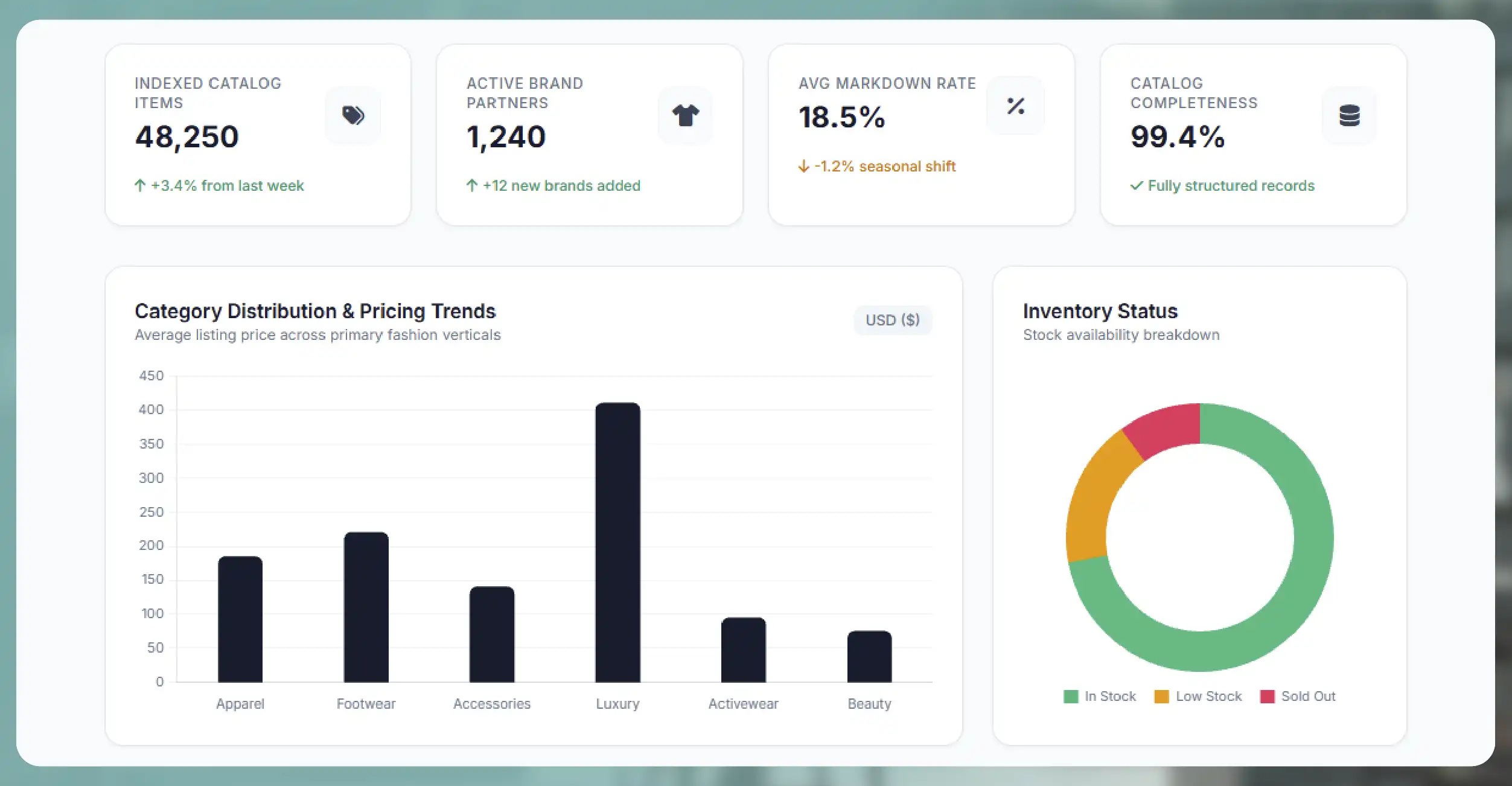
Nordstrom fashion product data refers to structured information associated with fashion and lifestyle products listed across an online retail catalog. Depending on the project requirements, datasets may include product identifiers, product titles, brands, categories, prices, promotional prices, product descriptions, images, colors, sizes, ratings, reviews, and availability.
The data can be organized into CSV, Excel, JSON, database tables, or other formats suitable for analytics and business applications. Businesses can also integrate extracted information with cloud databases, BI dashboards, internal applications, or competitive intelligence systems.
The most valuable aspect of structured fashion data is its ability to transform frequently changing retail information into an analyzable dataset. Historical snapshots can further help businesses identify pricing changes, assortment shifts, promotional patterns, and product lifecycle movements.
Key Data Fields to Collect
An API-based fashion product extraction project can be customized according to the business objective. Common fields include:
- Product name and product ID
- Brand and designer name
- Product category and subcategory
- Product URL
- Current price
- Original price
- Discount percentage
- Sale or promotional information
- Product description
- Product specifications
- Available colors
- Available sizes
- SKU or product identifiers
- Product images
- Ratings and review counts
- Stock or availability status
- Shipping-related information where publicly available
- Category breadcrumbs
- Product tags
- Collection information
Collecting these attributes in a standardized structure allows businesses to conduct product-level analysis rather than relying on manually captured information.
How API-Based Nordstrom Data Collection Works?
An API-driven workflow generally begins by identifying the required product categories, attributes, locations, and collection frequency. The extraction system then retrieves relevant product information and converts the collected content into structured records.
The first stage involves defining the target catalog. Businesses may choose categories such as women's apparel, men's clothing, shoes, handbags, accessories, beauty products, or designer collections.
Next, the extraction workflow collects product-level attributes. The system can normalize fields such as prices, category names, brand names, sizes, and availability so that records from different product pages follow a consistent structure.
The resulting information can then be validated for missing values, duplicate records, formatting inconsistencies, and unexpected changes. Finally, the cleaned dataset can be delivered through cloud storage, databases, APIs, scheduled exports, or business intelligence platforms.
This process creates a repeatable data pipeline rather than a one-time collection exercise.
Why Scrape Nordstrom Fashion Product Listings?
Fashion businesses operate in a highly competitive environment where prices and product assortments can change frequently. Automated product data collection helps organizations maintain a current view of market conditions.
Nordstrom fashion product data extraction can support competitive analysis by showing how products are positioned across brands and categories. Businesses can analyze pricing structures, discounts, product depth, assortment changes, and availability patterns.
Retailers can also use extracted information to compare their own product catalog against competitor assortments. This can help identify categories with pricing gaps, missing products, or opportunities for assortment expansion.
For fashion analysts, historical datasets can reveal seasonal trends and changes in consumer-facing product strategies. Product-level records collected over time can also support market intelligence models.
Stay ahead of fashion market changes with structured Nordstrom product, pricing, and availability data. Connect with iWeb Data Scraping to build a scalable API-based extraction solution that supports smarter competitive analysis and retail decision-making.
Competitive Pricing and Promotion Monitoring
Price is one of the most important variables in online fashion retail. A product can move from full price to promotional pricing, return to regular pricing, or become unavailable within a short period.
Nordstrom competitive pricing data Scrape workflows can monitor these changes systematically. Businesses can compare current and historical prices, calculate discount percentages, identify promotional periods, and benchmark selected products against competing retailers.
Price intelligence can help retailers establish competitive pricing strategies without relying solely on occasional manual checks. Analysts can also examine which brands and categories experience frequent price changes and which products maintain stable pricing.
Promotional intelligence can provide additional insights into seasonal campaigns, clearance activity, and discount intensity across different product categories.
Product Availability Monitoring
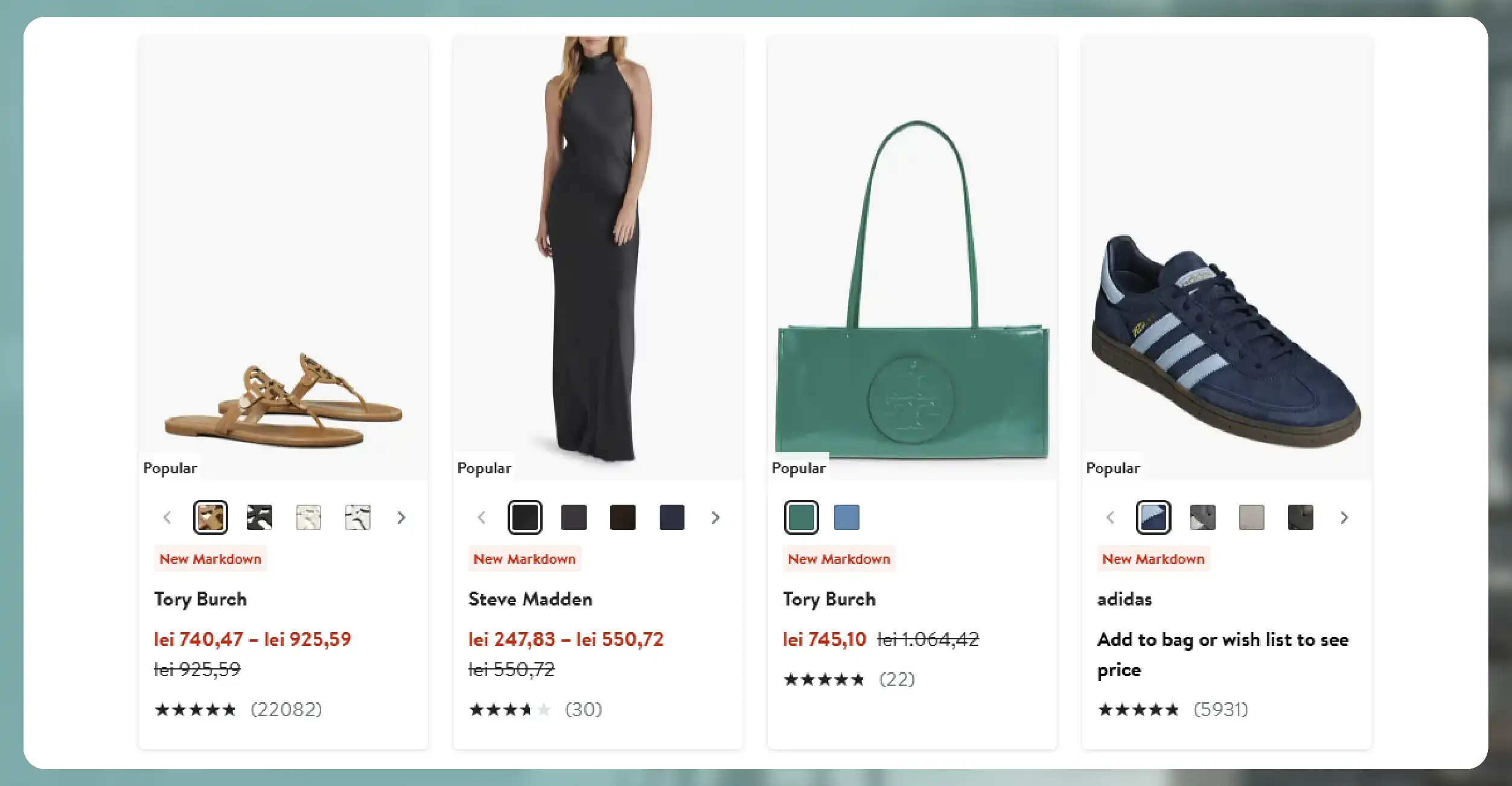
Product availability is another important element of fashion intelligence. A product may have multiple variants, and some sizes or colors may become unavailable while others remain in stock.
Scrape Nordstrom product availability data API workflows can help businesses monitor these changes at product and variant levels. Tracking availability over time can provide insights into product demand, inventory movement, and assortment health.
For example, repeated unavailability of specific sizes may indicate strong demand, while products remaining available for extended periods could signal slower movement. When combined with pricing and category data, availability information can provide a more complete picture of retail performance.
Nordstrom API Fashion Intelligence for Businesses
Nordstrom API fashion intelligence can transform raw catalog information into actionable business insights. By combining product, pricing, availability, brand, and category attributes, companies can develop dashboards and analytical models that provide a real-time or near-real-time view of the fashion market.
Fashion intelligence applications can include:
- Competitor price monitoring
- Product assortment comparison
- Brand performance analysis
- Discount tracking
- Product availability monitoring
- Seasonal trend analysis
- Catalog benchmarking
- Market opportunity identification
- Digital shelf monitoring
- Fashion category intelligence
Historical datasets can be particularly valuable because they allow analysts to compare present market conditions with previous snapshots.
Use Cases of Nordstrom Product Data
Retailers can use fashion product datasets to benchmark their pricing and product assortment. By comparing similar products and categories, businesses can identify pricing opportunities and improve catalog positioning.
Brands can monitor how their products are represented in online retail environments. This can help them identify pricing inconsistencies, availability issues, and assortment changes.
Market research firms can use structured datasets to analyze fashion trends and competitive positioning. Product-level information can be segmented by brand, category, price range, discount level, or availability.
E-commerce platforms can also use product datasets to enrich internal analytics systems and build competitive intelligence dashboards. Historical records can support forecasting and trend analysis.
Building a Scalable Extraction Pipeline
Large fashion catalogs require more than basic scraping scripts. A scalable architecture should account for pagination, changing product structures, duplicate records, request failures, data validation, and scheduled collection.
A typical workflow may include API request management, response parsing, field normalization, validation, deduplication, storage, and automated delivery.
Cloud-based storage can be used for large datasets, while databases such as PostgreSQL or other analytical systems can support querying and reporting. For large-scale workloads, distributed processing frameworks can help process substantial product datasets efficiently.
Scheduled extraction can also be configured according to business requirements. For example, pricing information may require more frequent updates than relatively stable product descriptions.
Data Quality and Standardization
Raw product information is only valuable when it is consistent and reliable. Data normalization can standardize currency formats, price fields, brand names, category structures, product identifiers, and availability values.
Duplicate detection prevents the same product from being counted multiple times. Validation rules can identify missing product names, invalid prices, incomplete URLs, or unexpected field changes.
A well-designed pipeline should also maintain timestamps so that businesses can determine when each record was collected. This makes historical comparison and change detection much easier.
Why Choose Nordstrom Data Extraction Services?
Professional Nordstrom data extraction services can provide customized collection workflows based on specific business requirements. Instead of creating and maintaining an internal extraction infrastructure, companies can use a managed solution designed around their target categories, data fields, update frequency, and delivery format.
A professional workflow can include data collection, cleaning, normalization, validation, storage, and scheduled delivery. The resulting dataset can be integrated with analytics platforms, dashboards, databases, or internal applications.
Businesses can also request customized datasets containing only the attributes required for their specific analysis, helping reduce unnecessary data processing and simplifying downstream analytics.
Benefits of Scraping Nordstrom Products Data
Scrape Nordstrom Products Data workflows provide several practical benefits for businesses working with fashion and retail intelligence. Automated collection reduces repetitive manual research and makes it easier to monitor large catalogs.
Organizations can create historical datasets to analyze pricing and availability changes over time. They can also compare brands, categories, products, and promotional strategies using consistent data structures.
For decision-makers, structured product information provides a stronger foundation for competitive research, pricing strategy, assortment planning, and market analysis.
How iWeb Data Scraping Can Help You?
Customized Data Collection
iWeb Data Scraping can develop customized workflows around your required Nordstrom categories, product fields, collection frequency, and delivery format, helping ensure the extracted dataset directly supports your business objectives and analytical requirements.
Structured Product Datasets
Our solutions can organize product names, brands, prices, discounts, categories, availability, sizes, colors, images, and other attributes into structured datasets, making the information easier to analyze, compare, store, and integrate.
Automated Data Updates
Scheduled extraction workflows can help businesses receive refreshed product information at defined intervals, enabling continuous monitoring of catalog changes, pricing movements, promotional activity, and availability without repetitive manual collection.
Data Cleaning and Validation
iWeb Data Scraping can apply normalization, validation, and deduplication processes to improve dataset consistency. Clean records make downstream reporting, competitive analysis, visualization, and business intelligence applications more reliable.
Flexible Data Delivery
Extracted information can be delivered through formats and storage environments suited to your workflow, including CSV, Excel, JSON, databases, cloud storage, or API-based pipelines for seamless integration with existing systems.
Conclusion
Fashion retailers and analysts need timely product intelligence to understand changing prices, assortments, promotions, and availability. Scrape Nordstrom Fashion Product Data solutions can help transform online fashion catalog information into structured datasets suitable for competitive analysis, market research, and retail intelligence.
Businesses can Extract Nordstrom Product Details with API workflows to collect product attributes at scale and organize them for dashboards, databases, and analytical applications. Automated collection can also support historical tracking, enabling companies to identify pricing movements and assortment changes over time.
With customized Web Scraping API Services, organizations can establish scalable data pipelines aligned with their specific product fields, update schedules, and delivery requirements. The result is a structured and reusable source of fashion intelligence that can support better pricing decisions, assortment planning, competitive monitoring, and strategic retail analysis.
FAQs
Product names, brands, categories, prices, discounts, descriptions, images, sizes, colors, ratings, product identifiers, URLs, and availability information can be collected depending on project requirements and permitted data access.
Collection frequency depends on business requirements. Data pipelines can be configured for periodic updates so businesses can monitor price, availability, promotional, and catalog changes over time.
Yes. Structured product, price, discount, and availability datasets can support competitive benchmarking, price monitoring, promotion analysis, and broader retail intelligence initiatives.
Datasets can be structured for formats such as CSV, Excel, JSON, databases, cloud storage, or API-based integrations, depending on the requirements of the project.
An API-based workflow can provide a scalable and automated approach to structured data collection, making it easier to process large catalogs, standardize records, schedule updates, and integrate datasets with business applications.