
41.7K+
TOTAL SELLER RECORDS PROCESSED

Scrape Sellers Information from Allegro to analyze seller performance, pricing strategies, product availability, ratings, competition, and marketplace trends.
This case study presents a real-world enterprise scenario where an eCommerce intelligence team leveraged automated marketplace data extraction to transform Allegro seller information into structured intelligence for competitive monitoring, pricing analysis, product research, and marketplace performance evaluation.
It is designed for:
The client's core challenge was straightforward: Allegro contains extensive seller and product information, but manually collecting, comparing, and updating these records across thousands of listings is difficult and inefficient. The objective was to build a scalable data intelligence layer capable of continuously converting marketplace information into actionable business insights.
A growing eCommerce intelligence organization required a reliable system for analyzing seller activity across Allegro, one of Poland's largest online marketplaces. The project focused on extracting seller profiles, product listings, ratings, reviews, pricing information, and marketplace activity at scale.
Using Allegro seller profile and rating data Extraction, the client developed a structured dataset containing seller names, ratings, review counts, product categories, listing information, prices, availability, and other marketplace attributes.
The resulting Allegro marketplace seller intelligence solution enabled analysts to compare seller performance, identify competitive movements, understand assortment differences, and detect changes in marketplace positioning.
Automated extraction pipelines continuously collected and normalized seller-level information, reducing dependency on manual research while improving consistency across large datasets. The structured information was then integrated into analytical dashboards and reporting workflows, helping stakeholders make faster decisions around seller benchmarking, product opportunities, pricing strategies, and competitive positioning.
The client was monitoring a rapidly changing Allegro marketplace containing thousands of sellers and an extensive range of products. Manual research required significant time and made it difficult to maintain consistent visibility across seller profiles, listings, ratings, prices, and product availability.
One major challenge involved competitor seller monitoring on Allegro, as seller assortment, pricing, ratings, and marketplace activity could change frequently. Without automated monitoring, identifying meaningful competitor movements was slow and inconsistent.
The client also required reliable Allegro seller pricing and product analysis to compare product prices, discounts, assortment depth, and listing availability across competing sellers.
Another challenge was limited Allegro seller performance analytics, which made it difficult to benchmark seller ratings, review volumes, product activity, and other marketplace indicators systematically.
The organization also faced fragmented data collection workflows. Information was gathered from individual marketplace pages and maintained manually, creating duplication, inconsistencies, and delayed reporting.
As the marketplace expanded, the existing process could not efficiently support historical tracking or large-scale seller comparisons. The client therefore required an automated system capable of collecting, cleaning, standardizing, and continuously updating seller information.
By implementing an automated seller intelligence pipeline, the client replaced fragmented marketplace research with a structured system that continuously captures seller profiles, product listings, pricing signals, ratings, reviews, and availability information across Allegro.
| Dimension | Manual Allegro Tracking | Client Data Scraping System |
|---|---|---|
| Data Collection | Individual seller and product page research | Automated multi-seller marketplace ingestion |
| Seller Coverage | Limited number of sellers | Thousands of seller records processed |
| Data Updates | Periodic manual collection | Scheduled and continuous extraction |
| Data Structure | Spreadsheets and manually maintained records | Standardized seller and product datasets |
| Pricing Monitoring | Manual price comparison | Automated seller-level price comparison |
| Rating Analysis | Individual seller review | Structured rating and review metrics |
| Product Coverage | Selective listings | Broad product and category coverage |
| Competitor Tracking | Reactive monitoring | Systematic competitor benchmarking |
| Historical Analysis | Difficult to maintain | Historical datasets for trend analysis |
| Reporting | Manual summaries | Automated dashboards and analytical outputs |
The brand in focus is an eCommerce intelligence organization focused on marketplace research, seller benchmarking, competitive analysis, and product-level intelligence. Its operations depend on obtaining accurate and continuously updated information from large online marketplaces.
As its Allegro monitoring requirements expanded, the organization faced growing volumes of seller records, product listings, ratings, reviews, and pricing information. Manual collection could no longer provide the speed or scale required for effective marketplace intelligence.
The organization therefore adopted an automated seller data extraction framework designed to transform marketplace information into structured datasets. The system provided centralized visibility into seller profiles, product assortment, pricing behavior, ratings, reviews, and marketplace activity.
This enabled the team to transition from reactive seller research toward continuous marketplace intelligence, supporting faster competitor analysis, product benchmarking, pricing decisions, and strategic planning.
We developed an automated marketplace intelligence pipeline designed to collect, clean, normalize, and structure seller and product information from Allegro. The solution captured seller names, profile information, ratings, review counts, product listings, prices, discounts, availability, categories, and other relevant marketplace attributes.
The project incorporated Allegro.pl data extraction services to establish scalable collection workflows capable of processing large volumes of marketplace information efficiently.
Our eCommerce Data Scraping Services supported automated extraction, structured data processing, deduplication, validation, and scheduled updates, ensuring that seller and product information remained consistent and analytically useful.
The pipeline also incorporated an Ecommerce Product Ratings and Review Dataset, allowing the client to evaluate customer feedback patterns, seller reputation, review volumes, and product-level sentiment indicators.
Extracted records were normalized into structured formats suitable for analytics platforms, databases, dashboards, and downstream machine learning workflows. Automated validation helped identify missing fields, duplicates, inconsistent seller records, and anomalous values before the information entered the final intelligence layer.
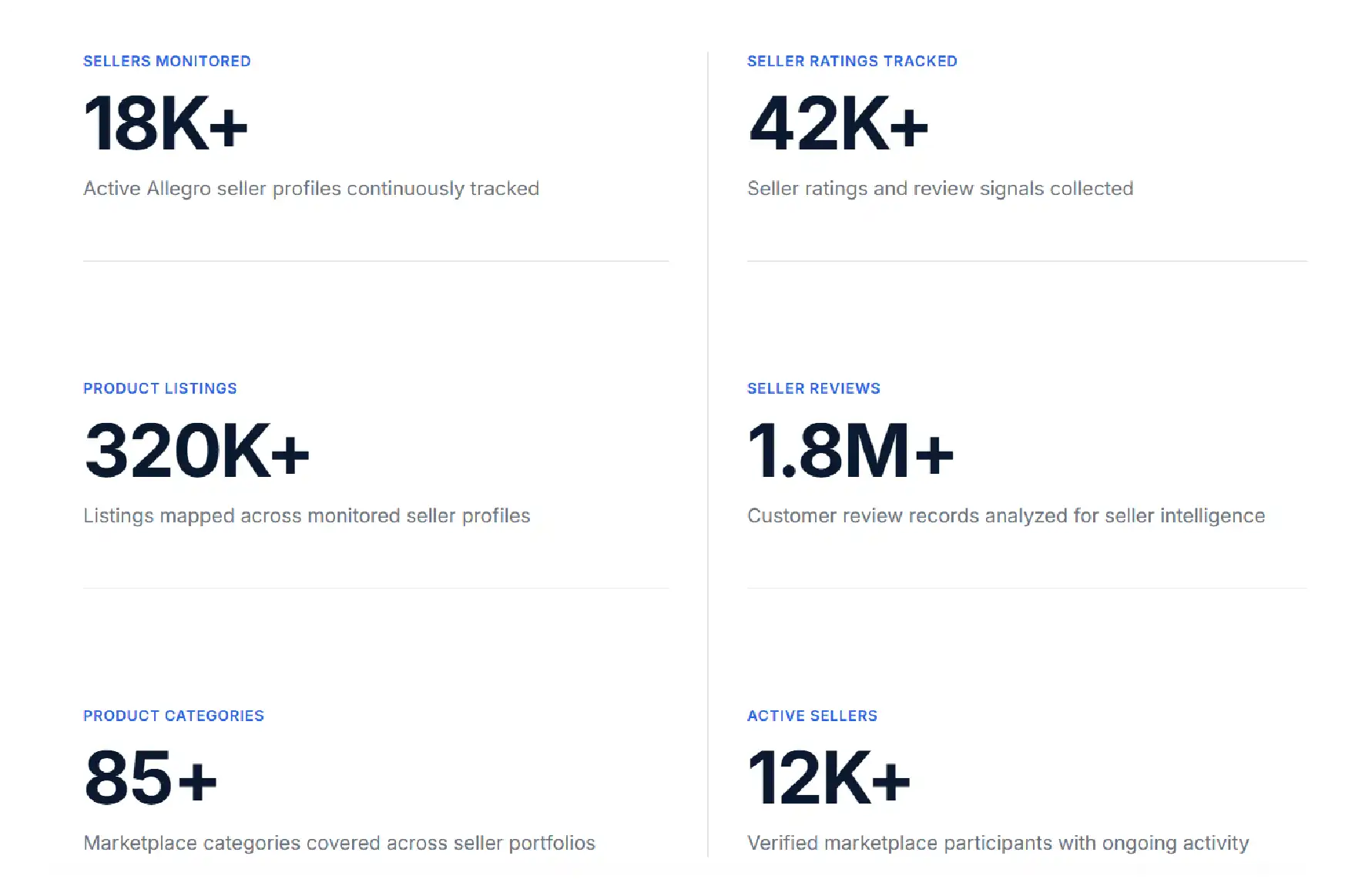
The implementation provided centralized visibility into seller profiles across the monitored Allegro marketplace. Instead of manually visiting individual seller pages, analysts could access standardized records containing seller names, ratings, review counts, listing volumes, product categories, and marketplace activity.
This made it easier to identify high-performing sellers, emerging marketplace participants, established competitors, and sellers with expanding product portfolios.
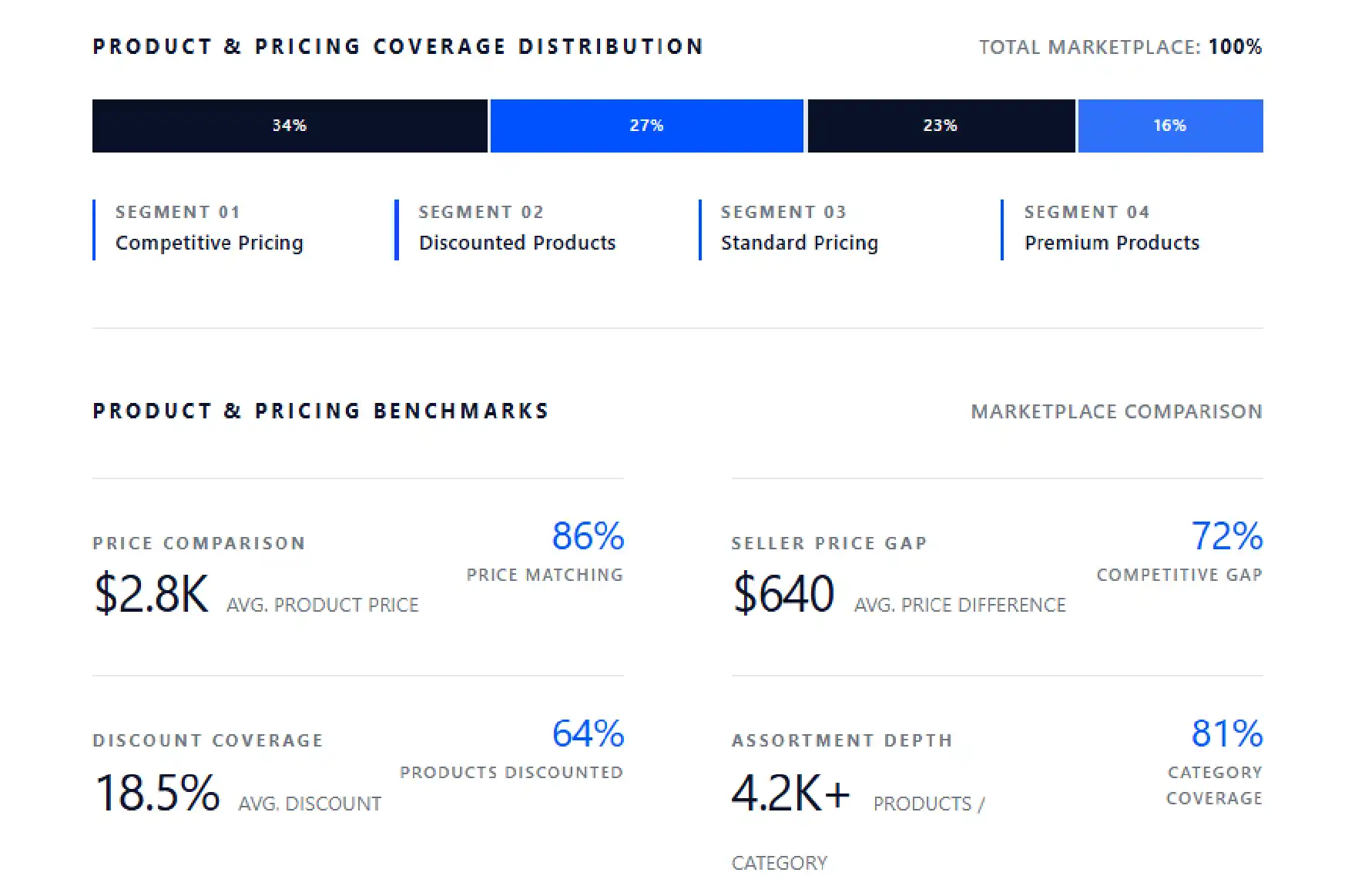
The structured dataset enabled systematic comparison of product prices and seller offerings across categories. Analysts could compare similar products, identify pricing differences, monitor discounts, and evaluate assortment depth.
This improved the client's ability to understand competitive price positioning and identify marketplace opportunities where product availability, pricing, or seller competition differed significantly.
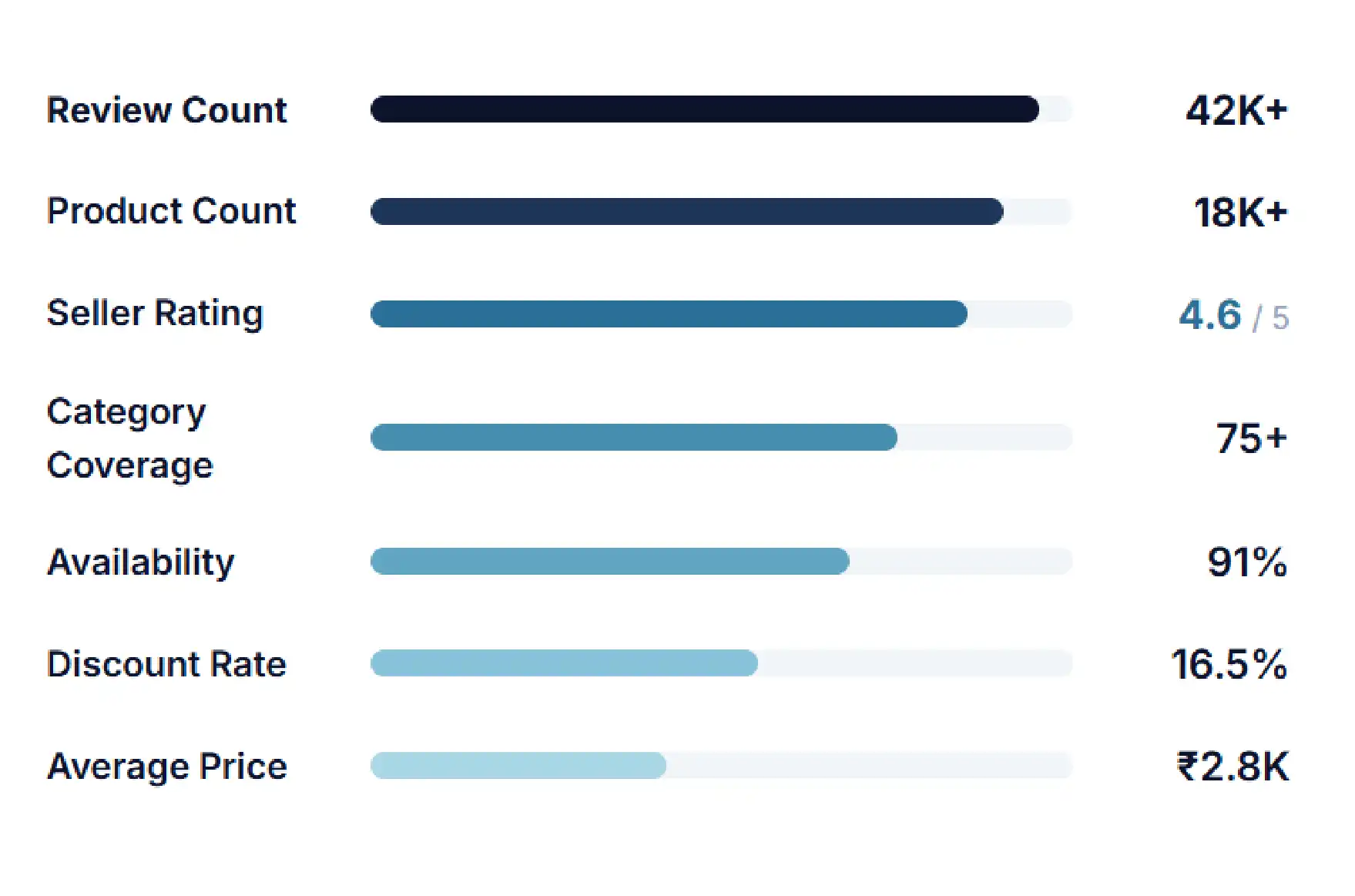
Seller ratings and review information were transformed into structured analytical metrics. The client could compare seller reputation, review volumes, rating distributions, and customer feedback indicators across marketplace participants.
This helped distinguish highly trusted sellers from lower-performing accounts and provided additional context for evaluating competitive strength and marketplace positioning.
| Metric | Insight Captured | Business Impact |
|---|---|---|
| Seller Rating | Average marketplace rating | Seller reputation benchmarking |
| Review Count | Volume of customer feedback | Seller activity and trust assessment |
| Product Count | Number of active listings | Assortment depth comparison |
| Average Price | Seller-level product pricing | Competitive pricing analysis |
| Discount Rate | Promotional pricing activity | Promotion benchmarking |
| Availability | In-stock or unavailable products | Supply and assortment monitoring |
| Category Coverage | Product categories offered | Seller specialization analysis |
| Listing Activity | Changes in active products | Marketplace activity monitoring |
The automated system enabled the client to monitor large numbers of sellers without increasing manual research requirements proportionally. Seller information could be collected, standardized, and analyzed at scale.
This improved competitive visibility and allowed the organization to identify changes in seller assortment, pricing, ratings, product availability, and marketplace participation more efficiently.
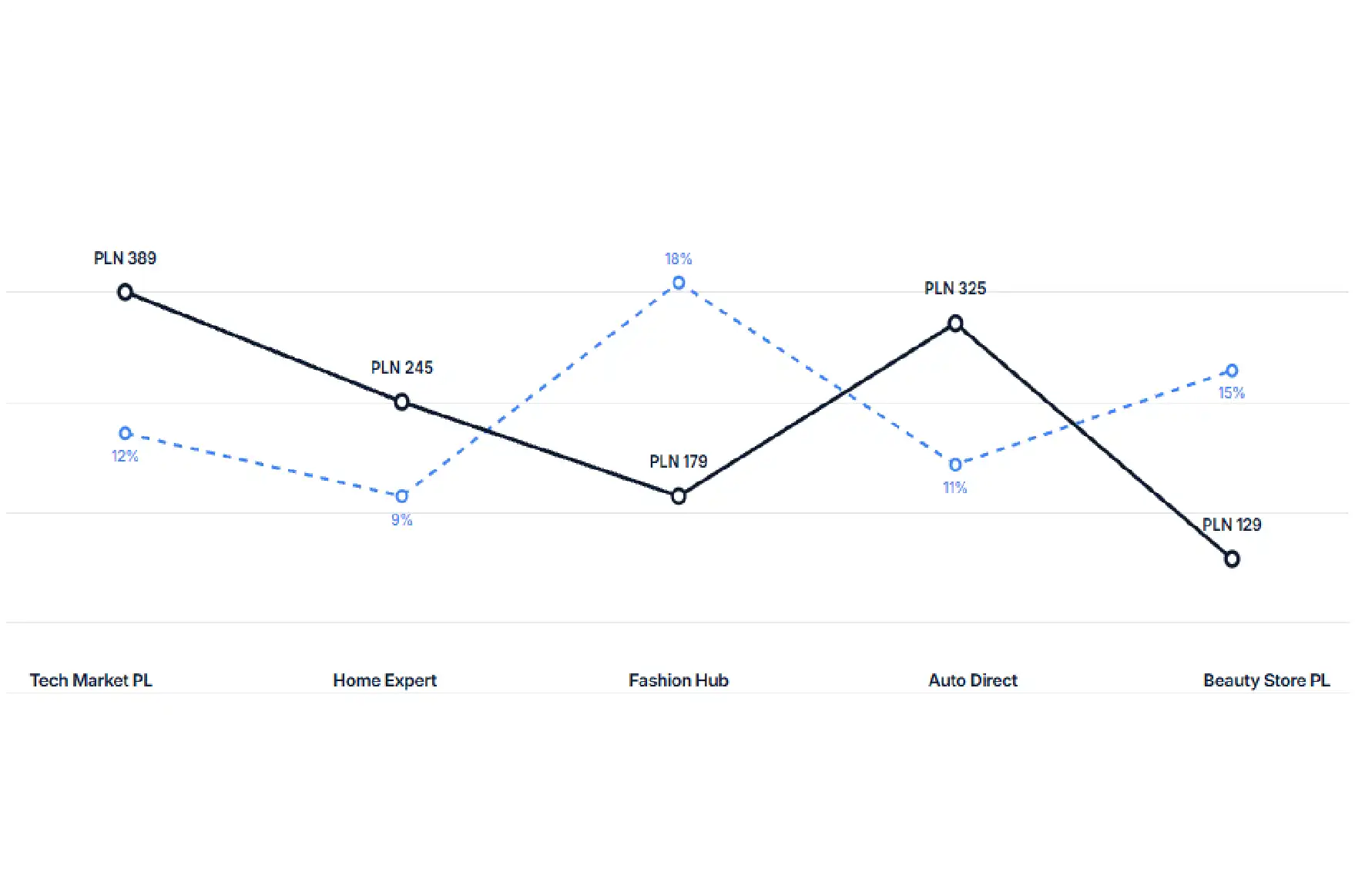
The sample dataset demonstrates how seller-level marketplace information can be organized for competitive intelligence and performance analysis. It combines seller identity, category coverage, product activity, pricing, ratings, reviews, and availability into a unified analytical structure.
| Seller Name | Category | Products Listed | Avg. Price | Rating | Reviews | Availability | Discount |
|---|---|---|---|---|---|---|---|
| Tech Market PL | Electronics | 1,245 | PLN 389 | 4.8 | 18,420 | 96% | 12% |
| Home Expert | Home & Garden | 986 | PLN 245 | 4.7 | 12,860 | 94% | 9% |
| Fashion Hub | Fashion | 1,578 | PLN 179 | 4.6 | 15,740 | 91% | 18% |
| Auto Direct | Automotive | 742 | PLN 325 | 4.5 | 8,920 | 89% | 11% |
| Beauty Store PL | Beauty | 1,104 | PLN 129 | 4.9 | 21,360 | 97% | 15% |
After implementing structured Allegro seller intelligence, the client achieved stronger marketplace visibility, faster competitive benchmarking, and improved access to seller-level product and pricing information.
Our approach provides businesses with structured marketplace intelligence that combines seller profiles, product information, pricing, ratings, reviews, and availability into unified datasets. This eliminates fragmented research processes and creates a reliable foundation for competitive analysis.
Automated collection improves operational efficiency by reducing repetitive marketplace monitoring activities. Teams can focus on interpreting insights instead of manually collecting information from individual seller and product pages.
The solution also supports historical analysis, enabling organizations to compare seller performance and marketplace changes over time. This helps identify emerging competitors, pricing shifts, assortment expansion, and changing seller reputation.
Our scalable architecture can process growing volumes of marketplace information while maintaining standardized data structures. This makes the system suitable for organizations monitoring large seller ecosystems and expanding product categories.
Finally, structured data supports better strategic decision-making by transforming raw marketplace information into actionable intelligence for pricing, assortment planning, competitor monitoring, seller benchmarking, and marketplace strategy.
"We were impressed by how efficiently the team transformed complex marketplace information into a structured and usable intelligence system. The solution gave us much better visibility into seller profiles, pricing, product assortment, ratings, and competitive activity. Automated collection significantly reduced our manual research workload while improving the consistency of our analysis. The resulting datasets have become an important resource for our marketplace benchmarking and strategic planning. We now have faster access to reliable seller intelligence and can respond more confidently to changes across the Allegro marketplace."
— Head of Marketplace Intelligence
The final outcome was a scalable marketplace intelligence infrastructure that transformed fragmented Allegro seller information into structured, analysis-ready datasets. The client gained improved visibility into seller profiles, product assortments, ratings, reviews, prices, discounts, and availability.
The implementation of eCommerce Data Intelligence enabled the organization to convert continuously collected marketplace information into actionable insights for seller benchmarking, competitive analysis, pricing research, and assortment planning.
Integration of Web Scraping API Services provided a flexible mechanism for delivering structured marketplace information to internal databases, analytics platforms, dashboards, and downstream applications.
The deployment of Web Scraping Services further supported scalable data collection and scheduled marketplace monitoring, enabling the organization to handle expanding seller and product volumes without relying on manual research.
Overall, the project delivered faster marketplace intelligence, improved seller benchmarking capabilities, reduced manual effort, and created a strong data foundation for future eCommerce analytics and competitive intelligence initiatives.
Seller name, profile information, ratings, review counts, product listings, categories, prices, discounts, availability, and other publicly available marketplace attributes can be collected and structured.
Yes. Scheduled extraction workflows can collect updated seller and product information at defined intervals, enabling historical comparisons and identification of changes in pricing, assortment, ratings, and marketplace activity.
Yes. Seller datasets can be combined with product-level fields such as product names, categories, prices, ratings, reviews, availability, discounts, and listing information.
Yes. Structured seller data can support competitor benchmarking, pricing analysis, assortment comparisons, seller performance evaluation, and marketplace trend monitoring.
Yes. Depending on project requirements, structured data can be delivered through APIs, databases, cloud storage, scheduled files, dashboards, or other integration formats.
Contact iWeb Data Scraping today to start your scalable seller data extraction project.
Start a projectFields marked * are required. Everything else just helps us scope faster — skip what you don't know yet.