

Introduction
Travel platforms generate enormous volumes of information that can help businesses understand destinations, hotels, restaurants, attractions, customer sentiment, pricing patterns, and travel demand. TripAdvisor is particularly valuable because its platform contains extensive destination, accommodation, dining, attraction, rating, review, and location information. Businesses can use structured data extraction techniques to transform this information into datasets for research, analytics, monitoring, and decision-making.
Scraping TripAdvisor API can help organizations collect structured travel information at scale when they have an authorized API, approved data-access method, or another legally permitted source. Instead of manually collecting thousands of records, an automated workflow can retrieve relevant fields and organize them into JSON, CSV, Excel, databases, or cloud-based data warehouses.
Scraping TripAdvisor review API can provide access to review-related information through an authorized data interface, where available. Review datasets can support sentiment analysis, reputation monitoring, service-quality research, and comparisons between properties or destinations.
Scraping TripAdvisor hotel data API can help collect accommodation information such as hotel names, locations, ratings, review counts, categories, amenities, and other publicly available attributes, subject to the applicable access terms and permissions.
What Is TripAdvisor API Data Scraping?
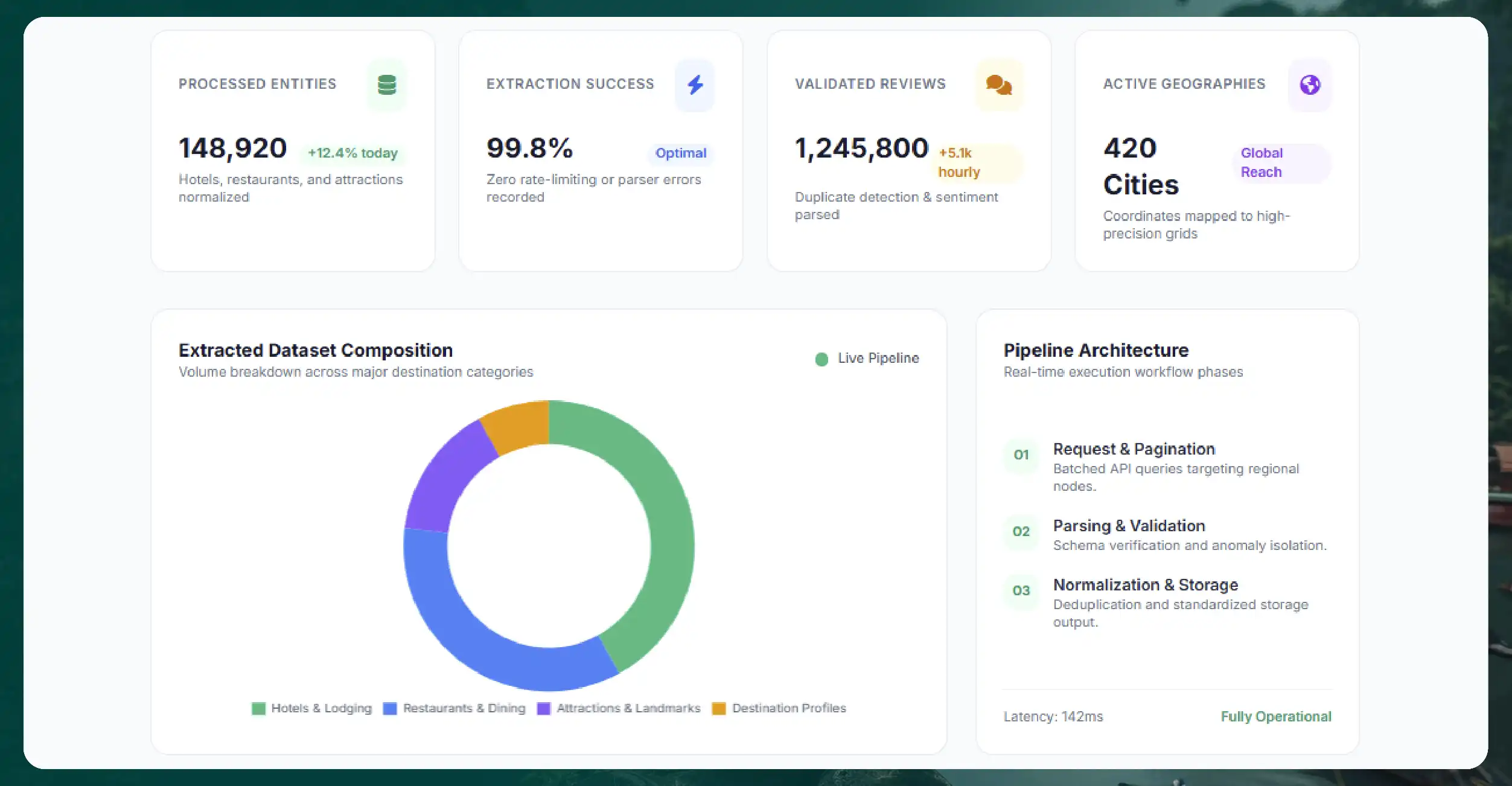
TripAdvisor API data scraping refers to an automated process for collecting structured information from TripAdvisor-related APIs or permitted web-access mechanisms. An extraction system sends requests, receives available data, processes the response, and stores selected fields in a standardized format.
The exact information available depends on the authorized API or data source. A travel data pipeline may include hotel information, restaurant profiles, destination details, attraction information, ratings, reviews, categories, addresses, geographic coordinates, and other relevant fields.
A reliable system generally includes request handling, pagination, response parsing, validation, duplicate detection, error management, data normalization, and storage. These components make the resulting dataset more useful for business intelligence applications.
Types of TripAdvisor Data You Can Collect
TripAdvisor-related datasets can be divided into several categories. Hotel data may include property names, addresses, ratings, review counts, accommodation categories, amenities, and location attributes. Restaurant datasets may contain restaurant names, cuisine categories, ratings, review volumes, price indicators, addresses, and operating information when provided through an authorized source.
TripAdvisor restaurant data scraping API workflows can organize restaurant information into structured datasets for competitive research, destination analysis, restaurant benchmarking, and market studies.
Travel datasets can also include attractions, destinations, activities, geographic information, and other travel-related entities. Combining these datasets can provide a broader view of tourism ecosystems instead of analyzing hotels or restaurants independently.
TripAdvisor travel data extraction API solutions can help businesses consolidate travel information into a standardized database, making it easier to compare destinations, accommodation providers, restaurants, and attractions across markets.
How the Data Extraction Process Works
A typical extraction pipeline begins by defining the required data fields and target entities. For example, a hotel research project may require hotel name, location, rating, review count, amenities, and category.
The next stage involves connecting to an authorized API or permitted data source. Authentication credentials, request parameters, pagination settings, and rate limits should be configured according to the provider's requirements.
The extraction layer then retrieves available records. Data validation is performed to identify incomplete responses, duplicate entities, malformed fields, or unexpected API changes. After validation, information can be transformed into a consistent schema.
TripAdvisor location data extraction API workflows can organize destination and geographic information into standardized records, supporting regional comparisons, tourism analysis, mapping applications, and location-based market research.
Finally, the processed data can be delivered to databases, dashboards, analytics platforms, or cloud storage. Common formats include JSON, CSV, Excel, and Parquet, while larger projects may use PostgreSQL, Snowflake, Amazon S3, Google Cloud, or Microsoft Azure.
Important Data Fields for Travel Intelligence
The value of a TripAdvisor dataset depends heavily on the fields collected. A hotel dataset, for example, can include property name, address, destination, rating, review count, accommodation type, amenities, and category.
Restaurant datasets can contain restaurant names, cuisine types, ratings, review counts, price categories, addresses, destination information, and other available attributes. Destination datasets can include location names, geographic information, attraction categories, and related travel entities.
Historical snapshots are particularly useful. Saving data at regular intervals makes it possible to identify changes in ratings, review volumes, property visibility, restaurant popularity, or destination activity over time.
TripAdvisor Market Intelligence Applications
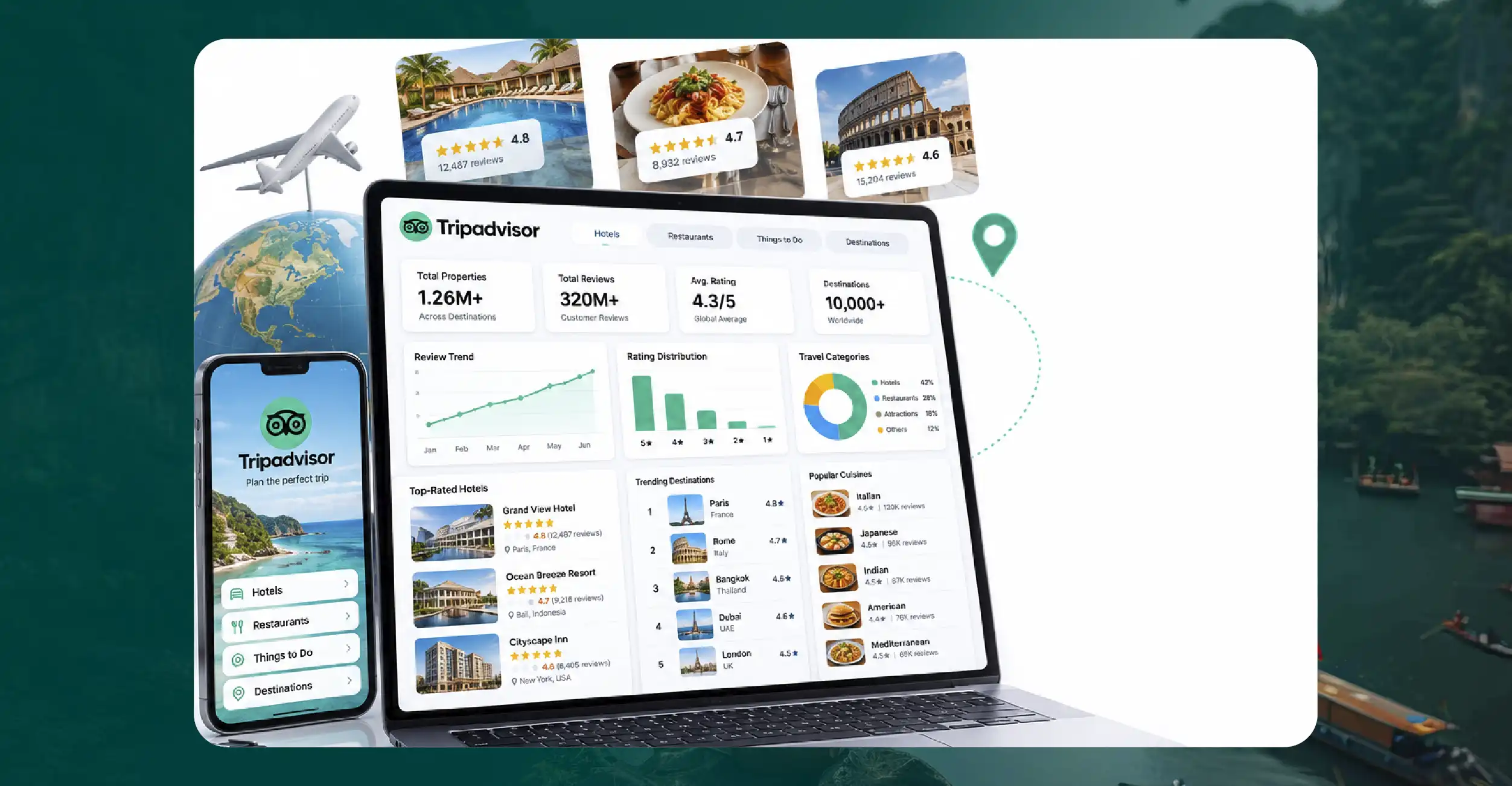
Travel businesses can use structured datasets to identify competitive patterns and emerging market opportunities. Hotels can benchmark their reputation against competing properties, while restaurant groups can compare ratings, reviews, cuisines, and market presence across destinations.
TripAdvisor market intelligence can support destination research by combining accommodation, restaurant, attraction, review, and geographic information. Analysts can use these datasets to evaluate market saturation, customer sentiment, competitive positioning, and changes in travel demand.
For example, a hotel company expanding into a new destination could compare competing properties by rating, review volume, amenities, and location. A restaurant group could analyze cuisine categories and customer feedback across several tourist markets before selecting a new location.
Hotel and Restaurant Competitive Monitoring
Competitive monitoring is another important application. Travel businesses can schedule regular data collection to track changes in selected entities over time.
Tripadvisor hotel and travel data Scraper systems can create recurring datasets for monitoring hotel and destination information. With historical snapshots, analysts can identify changes rather than relying on a single point-in-time dataset.
A monitoring solution can compare newly collected records against historical records to detect changes in ratings, review counts, categories, amenities, or other available attributes. This information can then be presented through dashboards or automated reports.
Review and Sentiment Analysis
Reviews provide qualitative information that can complement numerical metrics. When permitted review data is available, businesses can analyze recurring themes such as cleanliness, service, location, food quality, value, facilities, and customer experience.
Natural language processing can classify reviews by sentiment and topic. Positive and negative themes can then be aggregated by hotel, restaurant, destination, or time period.
This method to Scrape TripAdvisor Travel Data allows businesses to identify common customer complaints and strengths. Combining review sentiment with ratings and review volume can produce a more complete view of customer perception.
Data Cleaning and Standardization
Raw API responses are rarely ready for immediate business analysis. Data cleaning is therefore an important part of the extraction process. Duplicate records should be removed, text fields standardized, missing values identified, and geographic information normalized.
Entity matching is also important when combining TripAdvisor data with information from other travel platforms. Similar hotel or restaurant names may appear with different spellings or formats, requiring matching logic based on names, addresses, coordinates, or other identifiers.
A standardized schema makes it easier to integrate travel datasets into business intelligence tools and analytical workflows.
Scaling TripAdvisor Data Extraction
Large-scale extraction requires careful architecture. Request limits should be respected, and the system should handle temporary failures without creating unnecessary traffic. Pagination and incremental extraction can reduce redundant requests.
For large datasets, asynchronous processing, distributed workers, queues, and cloud storage can improve efficiency. Data pipelines may use Python, Requests, Pandas, Scrapy, or other suitable technologies depending on the authorized source and project requirements.
Monitoring should also be implemented to detect API changes, failed requests, schema changes, and unusual data volumes. This ensures that downstream dashboards and reports continue receiving reliable information.
Business Benefits of TripAdvisor Data Extraction
Structured travel data can support several business functions. Market research teams can identify competitive patterns, revenue teams can study market positioning, and product teams can develop travel comparison or discovery applications.
Historical datasets can also support trend analysis. By comparing periodic snapshots, organizations can identify changes in ratings, review activity, property coverage, destination popularity, and other measurable indicators.
Travel agencies, hotel groups, restaurant chains, tourism researchers, data companies, and analytics providers can therefore use properly collected TripAdvisor-related datasets to strengthen research and decision-making.
How Food Data Scrape Can Help You?
Travel Data Collection
Food Data Scrape can collect structured restaurant information, including names, cuisines, ratings, reviews, locations, menus, and other permitted attributes for comprehensive travel market analysis.
Restaurant Competitive Analysis
Analyze restaurant ratings, review volumes, cuisine categories, locations, and available pricing information to understand competitors, identify market gaps, and support strategic restaurant expansion decisions.
Review Intelligence
Collect permitted customer review data to identify recurring feedback, sentiment patterns, service concerns, popular dishes, and customer preferences, helping businesses improve restaurant experience and positioning.
Market Trend Analysis
Build historical restaurant datasets to monitor changes in ratings, review activity, cuisine popularity, restaurant availability, and destination-level trends across multiple geographic markets and segments.
Business Intelligence
Transform structured restaurant datasets into actionable intelligence for market research, location planning, competitive benchmarking, restaurant strategy, tourism analytics, and data-driven decision-making across multiple business functions.
Conclusion
Automated travel data collection can turn large volumes of publicly accessible or authorized TripAdvisor information into structured datasets for research, monitoring, and analytics. A well-designed pipeline should prioritize compliant access, reliable extraction, data quality, scalable processing, and secure storage.
Scrape Hotel Data from TripAdvisor to support hotel benchmarking, competitive research, reputation analysis, and destination intelligence when the required data is legally and technically accessible.
Scrape Restaurant Data from TripAdvisor to help analyze restaurant coverage, cuisine trends, ratings, review activity, and competitive positioning across selected markets.
Scraping of TripAdvisor Restaurants Data to further support restaurant intelligence platforms, tourism research, location analysis, and customer sentiment studies when conducted through permitted data-access methods.
Ultimately, a structured TripAdvisor data extraction solution can help travel businesses move beyond manual research and build repeatable datasets for market analysis, competitive intelligence, monitoring, and strategic planning.
FAQs
Structured data makes it easier to compare hotels, restaurants, attractions, ratings, reviews, locations, and other travel attributes across multiple destinations and market segments.
Businesses can compare available hotel attributes, ratings, review volumes, amenities, locations, and other permitted information to understand competitive positioning within specific destinations.
Review data can reveal recurring customer opinions, service strengths, common complaints, satisfaction patterns, and sentiment trends that may not be visible through ratings alone.
Yes. Properly structured TripAdvisor data can be combined with other permitted travel datasets to create broader analyses covering accommodation, restaurants, attractions, destinations, pricing, and customer behavior.
Data quality can be maintained through validation rules, duplicate detection, field normalization, error handling, schema monitoring, and regular checks for changes in the authorized data source.