

Introduction
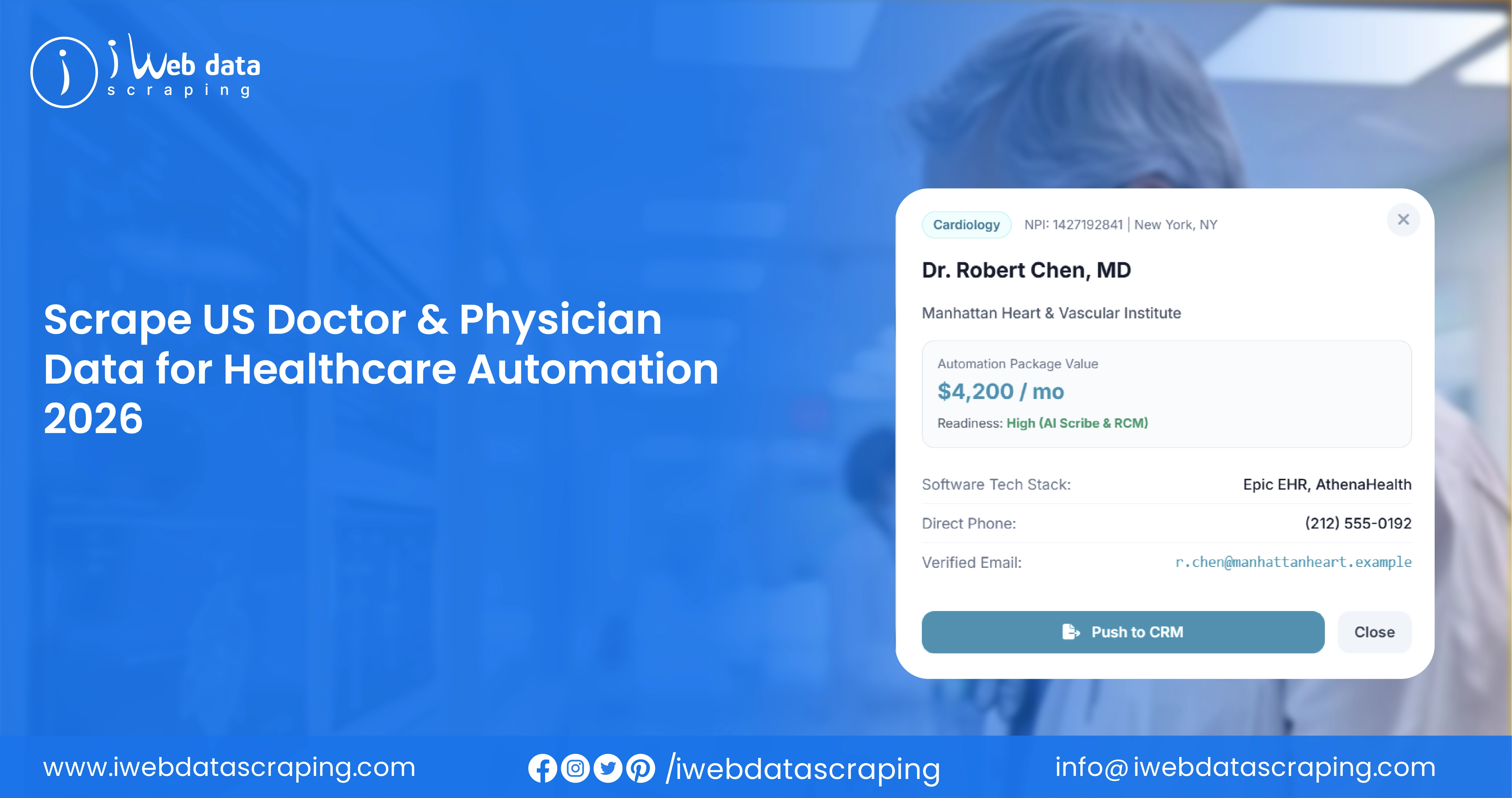
Healthcare is becoming increasingly data-driven, and physician information has emerged as one of the most valuable datasets for automation, provider discovery, healthcare networking, and market intelligence. In 2026, hospitals, health-tech companies, pharmaceutical businesses, insurers, staffing agencies, and healthcare platforms increasingly depend on structured provider information to make faster, more informed decisions.
Scrape US Doctor & Physician Data to build organized datasets containing physician names, specialties, practice locations, affiliations, credentials, contact information, services, and other publicly available professional attributes.
At the same time, US Doctor & physician data extraction for healthcare automation is helping organizations transform fragmented online information into machine-readable datasets that can support provider directories, referral systems, recruitment platforms, healthcare marketplaces, and business intelligence applications.
The challenge is that physician information is distributed across hospital websites, clinic directories, professional profiles, healthcare marketplaces, specialty directories, and other publicly accessible sources. Manually gathering and updating this information is slow, expensive, and difficult to scale.
That is where automated data collection becomes strategically important.
Why Doctor & Physician Data Matters in 2026?
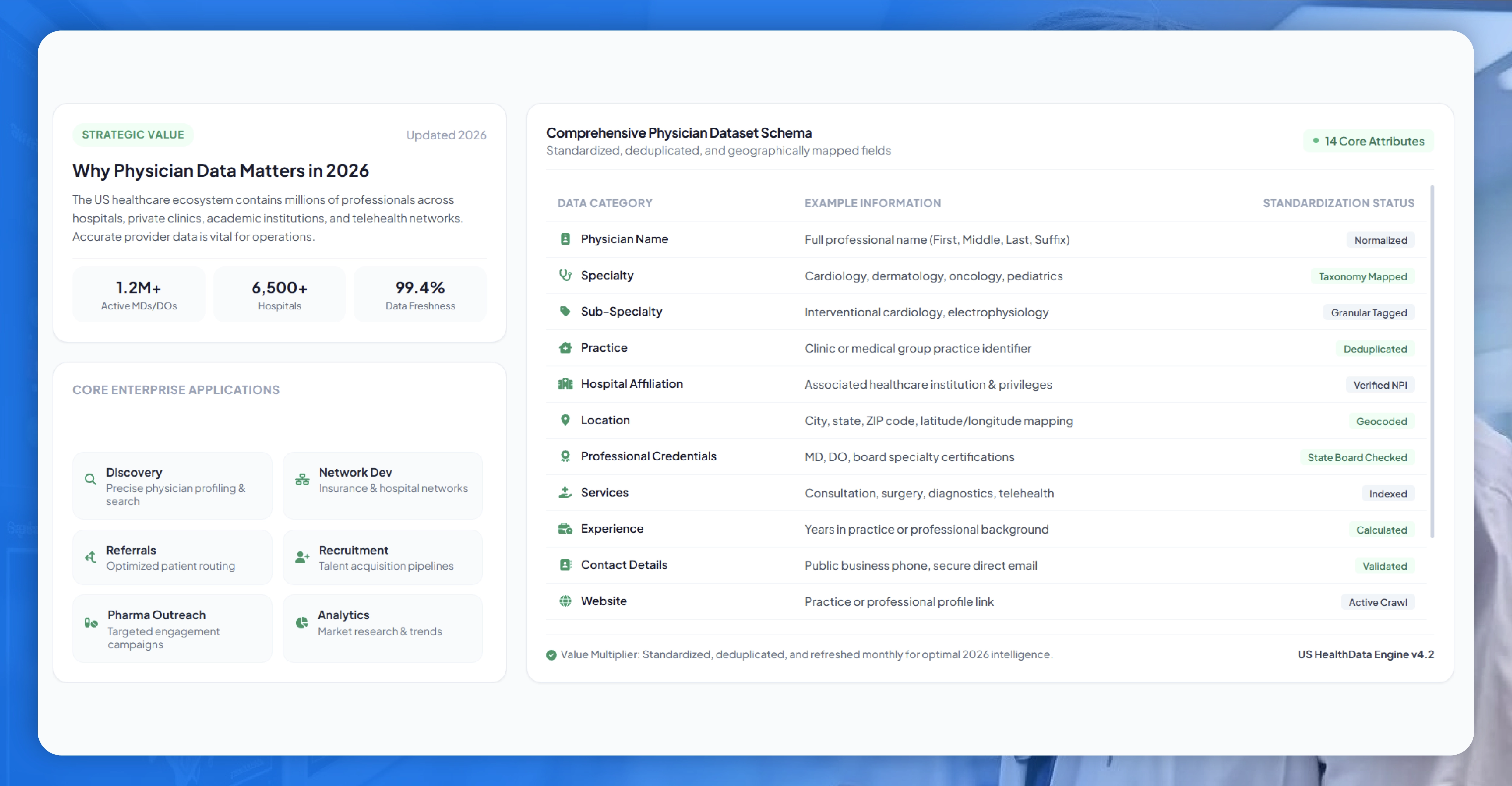
The US healthcare ecosystem contains millions of healthcare professionals operating across hospitals, private practices, specialty clinics, urgent-care centers, academic institutions, and telehealth organizations.
Organizations need accurate provider data for a wide range of applications, including physician discovery, network development, referral management, recruitment, pharmaceutical outreach, healthcare analytics, and competitive research.
A comprehensive physician dataset can include:
| Data Category | Example Information |
|---|---|
| Physician Name | Full professional name |
| Specialty | Cardiology, dermatology, oncology |
| Sub-Specialty | Interventional cardiology |
| Practice | Clinic or medical group |
| Hospital Affiliation | Associated healthcare institution |
| Location | City, state, ZIP code |
| Professional Credentials | MD, DO, specialty certifications |
| Services | Consultation, surgery, diagnostics |
| Experience | Years or professional background |
| Contact Details | Public business phone or email |
| Website | Practice or professional profile |
| Availability | Publicly listed appointment information |
| Languages | Languages offered by provider |
| Insurance | Publicly listed accepted plans |
The value increases further when these fields are standardized, deduplicated, geographically mapped, and refreshed regularly.
Building Automated Physician Data Pipelines
Automated Doctor & physician data collection in the USA can create a continuous workflow instead of a one-time extraction project.
A typical pipeline begins by identifying relevant public healthcare sources. Crawlers then collect available provider information, parse structured and unstructured fields, normalize the records, remove duplicates, validate information, and deliver the final dataset through a preferred storage or API environment.
For example, a healthcare automation platform could collect physician records from multiple public sources and standardize:
Name → Specialty → Location → Practice → Hospital → Services → Credentials → Public Contact Information
This structured architecture allows downstream applications to consume physician information without repeatedly navigating individual websites.
Automation also makes scheduled refreshes possible. Instead of maintaining a static spreadsheet, organizations can establish daily, weekly, or monthly data-refresh workflows based on business requirements.
Partner with iWeb Data Scraping to automate US doctor and physician data collection today.
Applications Across the Healthcare Industry
Physician datasets can support a surprisingly broad range of healthcare automation applications.
Provider Directory Automation
Healthcare websites and applications require
comprehensive provider directories. Automated extraction can help populate physician names,
specialties, locations, affiliations, services, and publicly available professional details. Regular
updates can also help identify changes in practice locations, affiliations, specialties, or publicly
listed services.
Healthcare Recruitment
Medical staffing companies and healthcare recruiters can
use structured physician datasets to identify professionals based on specialty, geography, practice
environment, and publicly available professional information. Instead of searching thousands of
individual profiles manually, recruiters can work with searchable datasets that support filtering
and segmentation.
Pharmaceutical Market Research
Pharmaceutical organizations can analyze physician
populations by specialty, geography, healthcare organization, and other relevant professional
attributes. For example, a company researching a particular therapeutic area could analyze physician
concentrations across states or metropolitan areas to understand potential market coverage.
Referral Network Development
Healthcare organizations can identify physicians and
practices within specific geographic regions and specialties to support referral-network analysis.
Geographic datasets can reveal physician density, specialty availability, and potential gaps in
provider coverage.
Healthcare Marketplace Development
Doctor-booking platforms and healthcare
marketplaces can use structured provider datasets to improve search and discovery. Patients may
search by location, specialty, services, language, or provider type. A clean underlying dataset
makes these filters significantly more useful.
From Raw Web Pages to Physician Intelligence
Raw web information is rarely ready for immediate business use. Physician names may appear differently across sources, specialties can have inconsistent terminology, and practices may operate under multiple names.
A sophisticated extraction workflow therefore requires several stages.
First, data discovery identifies relevant public sources and target fields. Second, automated extraction collects information from those sources. Third, parsing converts page content into structured records. Fourth, normalization standardizes names, specialties, addresses, phone formats, and other attributes. Fifth, deduplication identifies records referring to the same physician or organization. Finally, validation and quality checks help identify incomplete, outdated, or conflicting records.
This transformation converts scattered web information into a usable intelligence layer.
The Role of Healthcare Market Intelligence

US physician market intelligence becomes more powerful when physician records are combined with geographic, organizational, specialty, and market-level information.
For instance, a healthcare company could analyze:
- Physician density by state
- Specialists by metropolitan area
- Hospital affiliations
- Practice concentration
- Specialty growth
- Provider distribution
- Healthcare organization footprints
- Geographic service gaps
These insights can support expansion planning, recruitment strategies, competitive analysis, and healthcare market research.
Scaling US Provider Data Collection
US healthcare provider data scraping projects often involve thousands or millions of records, making scalability essential.
A production-grade architecture can incorporate Python-based crawlers, browser automation where appropriate, HTML parsing, proxy management, scheduling systems, data validation, cloud storage, and API-based delivery.
Large datasets may be stored in PostgreSQL, cloud databases, data warehouses, CSV, JSON, or Parquet formats depending on the downstream workflow.
Organizations can also integrate scraped datasets with CRM systems, business intelligence platforms, healthcare applications, analytics dashboards, or internal databases.
The objective is not simply to collect more data. It is to create reliable, structured, refreshable data pipelines.
Compliance, Privacy, and Responsible Collection
Healthcare data requires particular attention to privacy, security, and responsible data practices.
A physician dataset should focus on publicly available professional information rather than sensitive patient information. Organizations should respect applicable laws, website terms, access restrictions, robots directives where applicable, and contractual requirements.
Data minimization is equally important. Collecting every available field is not necessarily better. A responsible project should identify the minimum information needed for its specific business objective.
Security controls should also be applied to storage, transmission, access management, and downstream processing.
For organizations operating at scale, compliance should be incorporated into the architecture from the beginning rather than treated as an afterthought.
Pharmacy and Healthcare Data Opportunities
Pharmacy & Healthcare Data Scraping can extend physician intelligence beyond individual providers.
Healthcare organizations can combine physician information with pharmacy locations, healthcare facilities, medical services, specialty information, and other public business data to create broader healthcare market datasets.
For example, a healthcare analytics company could connect physician specialty data with geographic pharmacy availability to study potential service coverage across specific markets.
Similarly, pharmaceutical companies can combine provider intelligence with broader healthcare ecosystem datasets to understand regional healthcare structures.
This creates opportunities for multidimensional healthcare analytics rather than isolated physician directories.
Creating a Complete Healthcare Automation Framework
Healthcare Automation Complete Guide strategies should focus on building an interconnected data ecosystem.
A strong architecture can include source discovery, automated extraction, validation, normalization, deduplication, storage, monitoring, API delivery, and scheduled refreshes.
The workflow might look like:
Public Sources → Data Extraction → Parsing → Cleaning → Entity Matching → Validation → Database → API/Dashboard → Automated Refresh
Monitoring is particularly important. Websites change layouts, fields move, and new providers appear while existing records may change.
Automated monitoring can help identify extraction failures and data-quality anomalies before they affect downstream applications.
Combining Multiple Healthcare Data Sources
Healthcare and pharma data scraping can help organizations build datasets that extend beyond physicians alone.
Depending on the project scope, datasets may incorporate medical practices, hospitals, pharmacies, healthcare organizations, pharmaceutical companies, medical services, specialties, and geographic information.
Cross-source matching can reveal relationships that are difficult to identify from individual websites.
For example, connecting physician records with practice locations and hospital affiliations can provide a more complete representation of the healthcare provider ecosystem.
The result is a data foundation that can support analytics, automation, research, and strategic planning.
What Makes Physician Data Valuable for AI?
AI applications depend heavily on clean, structured, and consistently updated information.
A healthcare AI platform may need physician data to power provider recommendations, geographic searches, specialty classification, entity matching, lead scoring, or market analysis.
Poor-quality data can create duplicate providers, incorrect locations, outdated affiliations, or misleading search results.
Well-structured physician datasets provide the foundation needed for reliable automation.
This is why extraction should be treated as part of a broader data-engineering strategy rather than simply a scraping exercise.
How iWeb Data Scraping Can Help You?
Scalable Physician Data
iWeb Data Scraping can collect large volumes of publicly available physician information across multiple sources, organizing records into structured datasets for scalable healthcare applications.
Customized Data Fields
Your project can be configured around required fields such as specialty, location, practice, affiliation, services, credentials, and publicly available professional contact information.
Automated Data Refreshes
Scheduled extraction workflows can help maintain current datasets by repeatedly collecting publicly available information and identifying changes across physician and healthcare provider records.
Data Cleaning and Matching
Collected records can be normalized, standardized, deduplicated, and matched to improve consistency, helping businesses create dependable physician datasets for analytics and healthcare automation.
Flexible Data Delivery
iWeb Data Scraping can deliver structured healthcare datasets through formats and infrastructure suited to your workflow, including databases, cloud environments, files, dashboards, and APIs.
Conclusion
The growing demand for digital healthcare services makes structured physician intelligence increasingly valuable in 2026. From provider directories and recruitment platforms to pharmaceutical research, healthcare marketplaces, referral networks, and AI-powered applications, organizations need accurate and scalable professional data.
Pharmaceutical and Medical Data Scraping can complement physician-focused extraction by creating a broader healthcare intelligence ecosystem.
At the same time, scraping API Managed web scraping workflows can help organizations automate collection, processing, delivery, and recurring updates at scale.
The real opportunity lies beyond simply gathering physician records. By transforming fragmented public information into standardized, validated, and continuously refreshed datasets, businesses can create the data infrastructure required for smarter healthcare automation.
When implemented responsibly, physician data extraction can become a powerful foundation for market intelligence, provider discovery, operational efficiency, and next-generation healthcare technology.
FAQs
It is the automated collection of publicly available professional information about US physicians, such as names, specialties, practices, locations, affiliations, and services.
Healthcare marketplaces, staffing companies, pharmaceutical organizations, insurers, hospitals, health-tech companies, research firms, and provider-network businesses can benefit from structured physician data.
The ideal frequency depends on the application. High-change datasets may require daily or weekly refreshes, while less dynamic market research datasets may be updated monthly or quarterly.
Yes. Structured datasets can be delivered in formats such as CSV, JSON, databases, or APIs and integrated into analytics platforms, CRM systems, dashboards, marketplaces, and internal applications.
Yes. With appropriate crawling infrastructure, data processing, validation, storage, monitoring, and scheduling, automated collection can scale from targeted datasets to large provider intelligence programs.